2026.03.12
finding disingenuousness in de Duve's Duchamp's Telegram
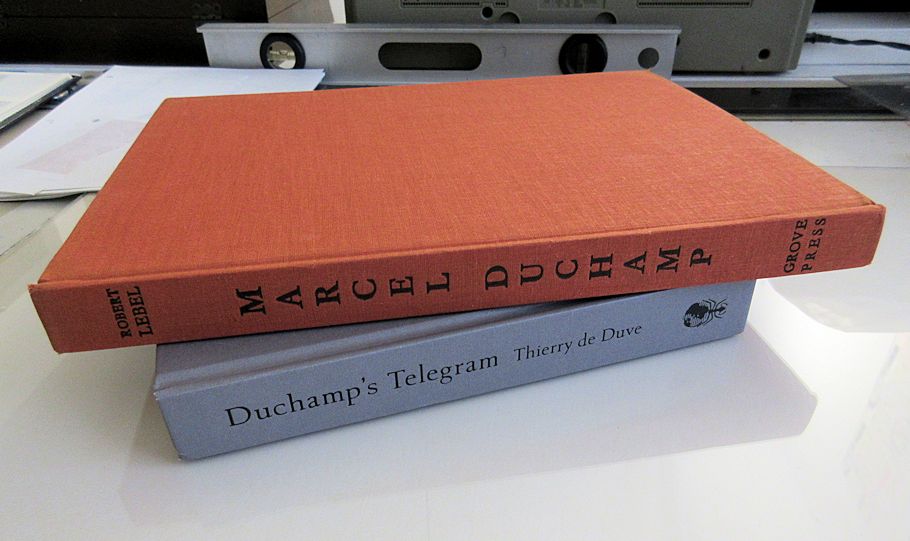
In thus far reading 242 of Duchamp's Telegram's 398 pages, it occurred to me to check whether Robert Lebel is listed in the book's index.
Question
What was the first monograph on Marcel Duchamp?
AI Overview
The first monograph on Marcel Duchamp was Sur Marcel Duchamp, written by French art critic and collector Robert Lebel and published in 1959. Developed in close collaboration with the artist, this comprehensive study included the first catalogue raisonné of his work and was released simultaneously in French and English editions.
Key details about the first monograph:
Author: Robert Lebel.
Release Date: Late 1959.
Publisher: Trianon Press (Paris) and Grove Press (New York).
Significance: It was a collaboration that took six years to complete, featuring input from Duchamp, André Breton, and H.P. Roché.
Components: It included an analysis of his art, a bibliography, and a catalogue raisonné.
As I suspected, Robert Lebel is not listed within the index of Duchamp's Telegram.
The On or About [Dick] Mutt telegram:
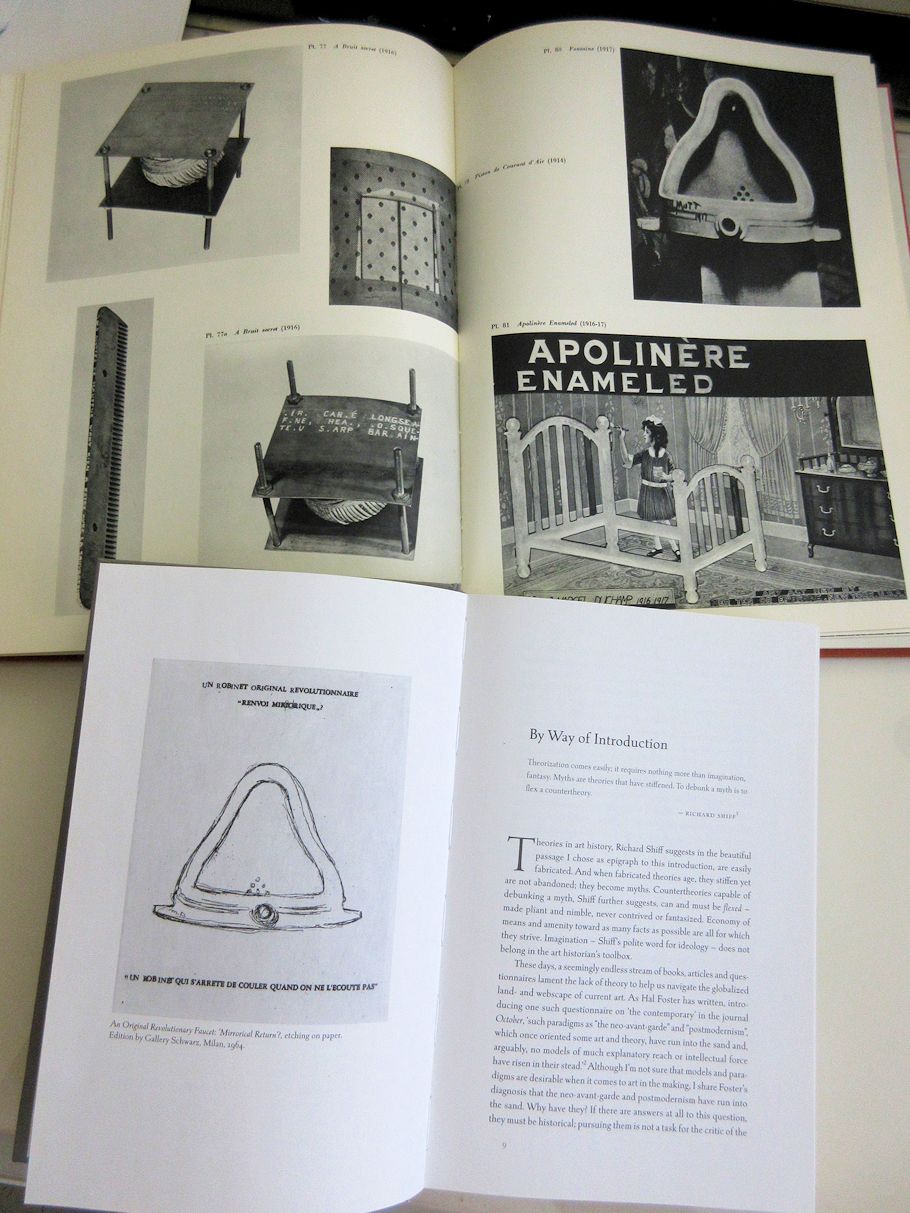
For Duchamp the very fact of turning upside down so familiar an object as the Bicycle Wheel, or later the Fountain, seemed enough to make it his own. . . To the first exhibition in 1917 of the Society of Independent Artists of which he was a founder-member, he sent anonymously a urinal entitled Fountain, a ready-made signed 'R. Mutt' which was refused. Since he felt that his relations with the independent artists, both in Europe and America, has proved enough as it was, he resigned at once from the only group he belonged to.1. . . 1. With John Covert, Walter Arensberg's cousin, Duchamp had helped in the preparation for this show, without warning anyone of his pseudonymous entry. It was he who suggested hanging the works in alphabetical order, the letter with which to begin being drawn each year by lot. His also was the discovery, at the same exhibition, of a new American painter, Louis Eilshemius. . . This was about the time of the first Independent Show in New York which Duchamp had helped to organize. His own contribution was banned from the show, not because it was titled Fountain and signed by the pseudonym 'Mutt", but because it too closely resembled a urinal (which it was). . . the latrine that was exhibited in 1917 at the New York Independents Show under the title fountain and which Duchamp was forced to withdraw after the opening, as a result of which he resigned from the Association . . . 132 / FOUNTAINE / [PL. 80] / [FOUNTAIN] / 1917 (New York / Ready-made: urinal turned upside down 24 in. high / Left: R. Mutt 1917 (Rudi Blesh in Modern Art U.S.A. suggests that 'R. Mutt' was derived from the famous comic strip characters Mutt and Jeff, or from Richard Mott, a well-known manufacturer of bathroom fixtures.) / Original lost / Replica in the original size 1950 / Small replicas for the Boîte-en-Valise / Coll. : Original acquired by W. Arensberg at the Independents, 1917 (afterwards lost) / Exh. : 'The Independents', New York, 1917 (refused or hidden) / 'Challenge and Defy', S. Janis Gallery, New York, 1950, No. 10 (replica) / Repr. : The Blind Man, No. 2, New York, 1917 (photograph by Alfred Stieglitz) / Boîte-en-Valise (small replica) / View, 1945, p. 32 (photograph by Alfred Stieglitz) / Sidney Janis, New York (replica) . . . 175 URINOIR / [Urinal] / Model for a series of 300 made for the Boîte-en-Valise / 1938 (Paris) / Papier-mâché sculpture 3 x 1 3/8 x 1 3/8 / Mme Maria Martins, Rio de Janeiro
2025.03.12
451 Rhawn Gallery
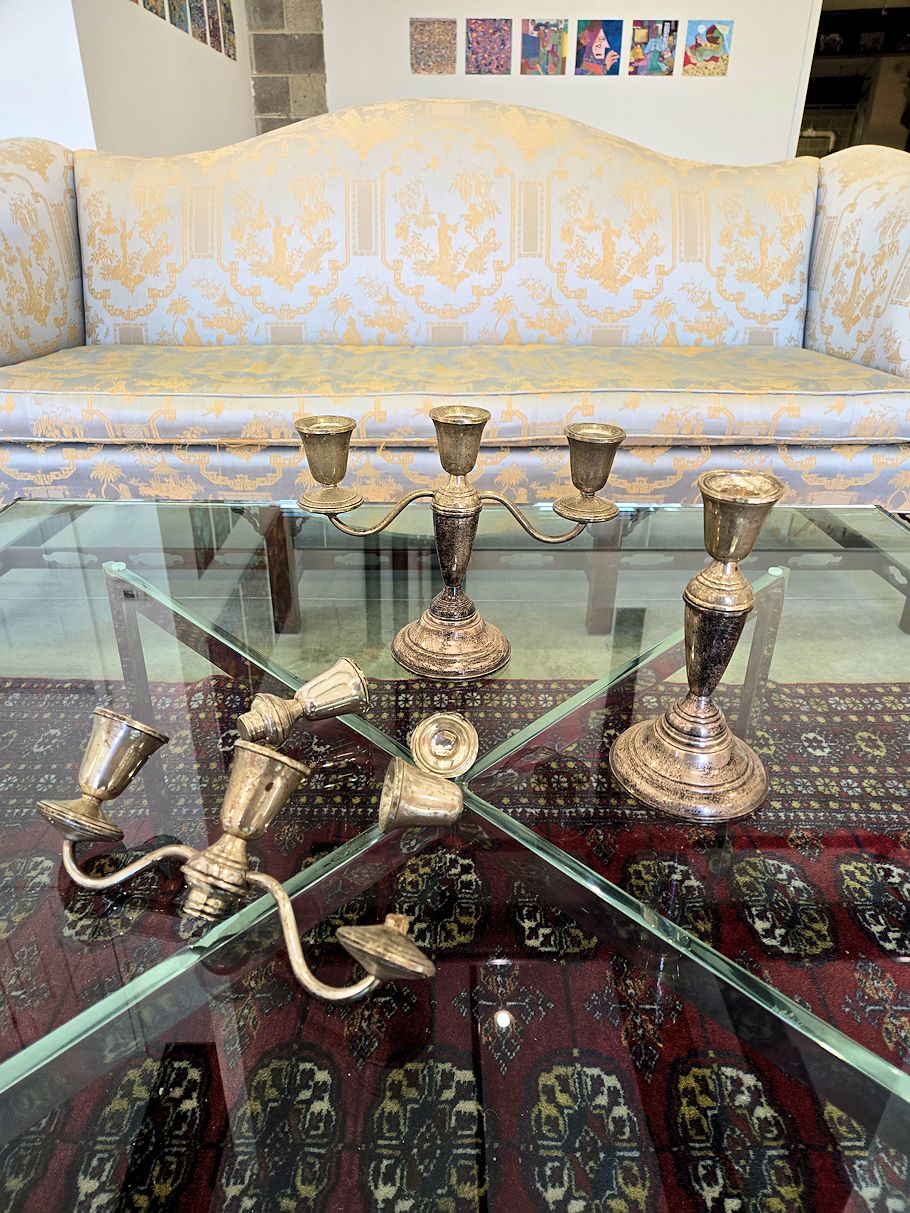
With these candlesticks my mother had three cendles burning atop the television set while we watched the funeral of President John Fitzgerald Kennedy
12:28
2023.03.12
From The Discovery of Piranesi's Final Project
12 March 2023 Sunday
Not until this afternoon while working on tomorrows page did I learn (again) that Miers Fisher died today in 1819. A kind of calendrical coincidence echo of my finding out about the Constantinian Lateran basilica on the date of Piranesi's death.
It's metaphysically strange to ask myself why all these people and discoveries are falling into my lap, while it's a reality for me now to know what it's like having my brother fall into my lap to save him from falling potentially crushingly onto the floor--three times in the last 24 hours.
Interestingly, and perhaps even fortuitously fittingly, Miers Fisher died (and often lived) on the same block as (or on the block facing) the National Constitution Center. It's almost 25 years since I've walked on that part of Arch Street.
2022.03.12
12:28
2017.03.12
12:52
zero zero one
2007.03.12
...and speaking of random tangents
"In a sense Asimov, Heinlein, and the masters of American Science Fiction are not really writing of science at all . . . They're writing a kind of fantasy fiction about the future, closer to the Western and the Thriller, but it has nothing really to do with science . . . Freud pointed out that you have to distinguish between analytic activity. which by and large is what the sciences are, and synthetic activities which are what the arts are. The trouble with the Heinlein-Asimov type of Science Fiction is that it's completely synthetic. Freud also said that synthetic activities are a sign of immaturity, and I think that's where classical Science Fiction falls down."
--Ballard, Speculation, 1969.
Upon first reading this passage, thoughts of how Piranesi's Il Campo Marzio dell'Antica Roma and particularly the Ichnographia Campus Martius have been largely misinterpreted by 20th century architectural 'scholarship' came to mind. The synthetic quality of Piranesi's archaeology (before archaeology was formalized into a science) is all the critics/theoreticians saw, and they completely discounted the analytical aspect of Piranesi's archaeology. Basically, a non-analytical analysis resulted in a synthetic interpretation.
The wonderful thing about Il Campo Marzio dell'Antica Roma (including the Ichnographia Campus Martius) is that the distinction between the analytical and the synthetic is never manifest--the work seamlessly embodies both natures.
[note to self: think about an updated republication of "Theatrics Times Two" and "Theatrics Times Two, too".]
"Science now, in fact, is the largest producer of fiction. A hundred years ago, or even fifty years ago even, science took its raw material from nature. A scientist worked out the boiling point of a gas or the distance a star is away from the Earth, whereas nowadays, particularly in the social, psychological sciences, the raw material of science is a fiction invented by the scientists. You know, they work out why people chew gum or something of this kind . . . so the psychological and social sciences are spewing out an enormous amount of fiction. They're the major producers of fiction. It's not the writers anymore."
--Ballard, Speculation, 1969.
...and speaking of random tangents
As to "It raced so fast the pulse exited a specially prepared chamber before it even finished entering it," that book may already be written---perhaps either Einstein's General Relativity or Special Relativity. (But don't quote me on that.)
As it stands, to me, the sentence relates the pulse being quickly stretched between the entry and exit points of the chamber.
But the sentence may not even be correctly describing what really happened:
Perhaps it meant to say the pulse completely exited the chamber at a time in the past relative to its entry time.
or
Perhaps it meant to say the pulse bilocated, being at two locations but not at the same time; again, the second space/time occurred before the first space/time.
(I wouldn't trust how journalists describe the result of the experiment at this point.)
This is what the whole time warp theory is about. Or at least it's what it used to be all about. Or maybe theories quickly exit before they finish entering.
It is said that St. Catherine de Ricci (at least) once in her life bilocated. A very rare attribute, even among 'saints'.
1957.03.12
1957. Tuesday, New York City
After inspecting the damage to Nu descendant un Escalier, No.2 [18.3.1912] the previous day, Duchamp reports in writing to Henri Marceau at Philadelphia.
Ephemerides
|