2024.02.16
a work within This One's for George
a work within This One's for George
2021.02.16
13:01
2017.02.16

Pennypack Park
2017.02.16
Started
César Aira's The Hare, because he's supposedly "The Duchamp of Latin American literature."
Lynne Tillman's The Complete Madame Realism and Other Stories. So far, "She could have been biding her time to protecting it. All ideas are married." Then, calendrically coincident, "Anything can be a transitional object. No one spoke of limits, they spoke of boundaries. And boundaries shift, she thought, like ones do after a war when countries lose or gain depending upon having won or lost. Power has always determined right."
2016.02.16
architectural otherness
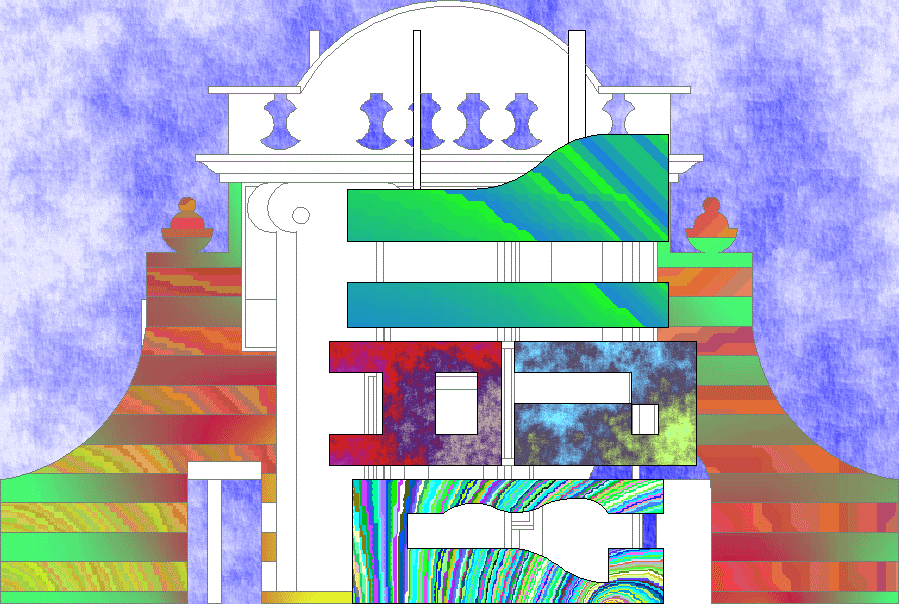
Good-Bye House
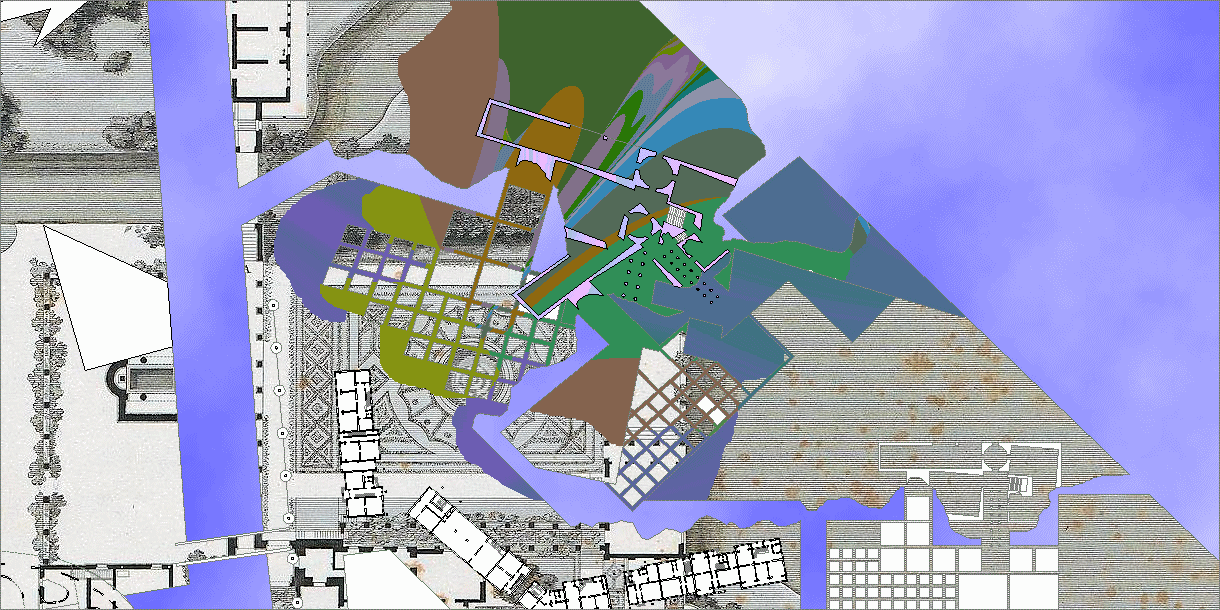
Ludi for Schinkel
2013.02.16
What are architects immediately critical of when entering a building?
I'm pitching the script as Fassbinder meets Midnight in the Garden of Good and Evil--creating a new genre even: the fashion police action film. Playing with a new title, but can't decide on Days of Daze or Daze of Days. Hey, maybe Go Figure!
2006.02.16
Iconography, or the problem of representation
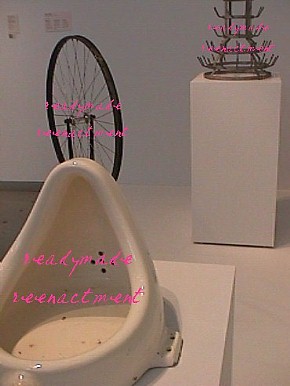
Look, it's another virtual museum of architecture!
division isolation separation boundaries oh my!!
I'm gradually getting into an architecture that crosses boundaries.
2004.02.16
only perfect hand free drafters can become architects
So if you don't have (use of) your hands you can't be an architect?
So that means a designer with one hand missing or with artificial hands using CAD just can't be an architect?
Perhaps there will need to be a law to stop this discrimination (thinking), like when CAD is voice activated.
2003.02.16
Re: bankruptcy exhaustion and closure
I was simply pointing out that to "try and imagine what people will believe or understand about it in a hundred years" was the same as "responding to fluid boundaries." You were being critical of an avant-garde responding to fluid boundaries, yet your own argument was itself based on responding to a fluid boundary. It was also you who equated responding to a fluid boundary with responding to an unknown. From my perspective, all this pointed to flaws within your internal logic. I also just looked up 'ingenuine' in the dictionary and did not find the word. I took it to mean non-genuine, thus a non-genuine pretended, due to a sort-of double negative, turns out to be the real thing.
I raised the notion of liquid boundaries in addition to solid boundaries, and I was thinking specifically of how the virtual, as it is now-a-days manifest via the internet and cyberspace, is a liquid world in addition to the solid real world. The notion of solid bound and liquid bound realms is not relegated to a combination of the internet and the real, however, for your response is a perfect example of how the solid and the liquid (fluid) coexist, albeit, you yourself were not even aware of utilizing the 'boundaries' of both realms.
The nature of liquid/fluid boundaries appears to be a topic worth further hashing out.
2000.02.16
Re: Theory dynamics; what theories?
Saul writes:
Stephen Lauf proposed a different sort of dynamic as governing architectural theories, based on metabolism (!) I don't see how that view could be anything other than metaphorical, but it is intriguing if only because it raises one sort of alternative view (and thus introduces the notion that there could well be various competing accounts of architectural theory dynamics--hence one important task is to first grasp what those candidates are).
Steve replies:
I am not proposing "a different sort of dynamic as governing architectural theories, based on metabolism." Rather I am working out a theory (chronosomatics) whereby human imagination reenacts corporal physiology and/or morphology. The metabolic imagination is just one of the human imaginations; the others include the extreme imagination, the fertile imagination, the pregnant imagination, the assimilating imagination, the osmotic imagination, the high-frequencies imagination. I then further theorize that these various operative modes of imagination in turn are reenacted in architecture.
For example, I see the Pantheon and Kahn's Kimbell Art Museum as both prime example of an architecture that reenacts the osmotic imagination, which is an imagination that reenacts the physiological process of osmosis, which is the equalizing diffusion of concentrations either side of a semipermeable membrane. Both the Pantheon and Kimball are semipermeable (each in its own way) and both buildings work towards 'equalizing' the outside and the inside (again each in its own way). Furthermore, osmotic architecture seems to often capture a 'sacred' quality.
There are many other examples that I have thus far made note of…
|