2026.02.14
enigma . . . or knot 001
enigma . . . or knot 002
enigma . . . or knot 004
enigma . . . or knot 007
enigma . . . or knot 011
2023.02.14
From The Discovery of Piranesi's Final Project
14 February 2023 Tuesday
Did Francesco do all the script etching? I.ve been wondering that for a number of months now. Does it mean anything if Francesco did do all the script etching (of the plates associated with his name)? For one thing, it would mean that he was very good at it, script etching, that is, for the is so much of it, a nimiety even.
Was it perhaps even Francesco who came up with the idea of excelling at script etching by training one's opposite writing hand to (simultaneously write as a mirror-image would have it?
2021.02.14
Untitled
2007.02.14
Artificial islands from all around the world
"She be syncin'"
2006.02.14
non-event cities
When I was very little, probably in 1960, about once a month on Friday nights my parents would take me and my brother to "the south." I can still vividly remember my first trip there because it seemed like we went to Hell. We were first greeted by multiple barrels in the street with open flames coming out their tops, and lots of noise and smells and trash everywhere, and there were dead animals all over the place, I mean dead fish and dead rabbits and dead chickens, and I got really afraid when I saw my father going into a big dark room with dead pigs and cows hanging in it. Of course, my older brother was no help because he made me touch the dead animals as we walked by them.
After several trips my brother and I put up such a fuss that we were allowed to stay home, and I never wanted to go to "the south" again.
Fifteen years later in my first year of architecture school, the teachers wanted us students to learn and experience the city, "and everyone should go to the Italian Market in South Philadelphia, it's vibrant and lively."
2004.02.14
Re: of castles, fortifications, etc.
Great stuff. Mecca and WTC, what a comparison. You seem to be asking (and answering) "how does one design a site of pilgrimage well?" I agree that this is an apt question for design these days. Lucky for me, I suppose, my 'pilgrimage' to the post 9-11 WTC occurred the first weekend Lower Manhattan was reopened after the attack. A true once in a lifetime event. I haven't visited the Pentagon or Shanksville yet, however.
Architect Aldo Rossi also held the lighthouse typology in high regard. If you are not familiar with his many architectural sketches (many of which are published in a fair number of books), you might find lots of inspiration related to your own work. His collecting of favorite typologies is much akin to your own collecting of the 'architecture of electricity'.
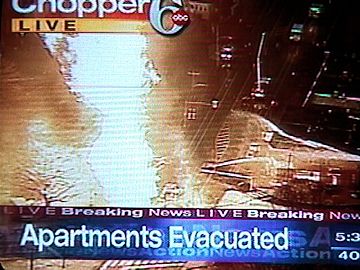
Last evening Philadelphia was witness to a great 100' to 150' column of fire. Ten minutes before 5 o'clock a small crew of water workers at the intersection of Olney and Ogontz Avenues (about 2.5 miles directly west from where I live) accidentally broke open a 20" gas main, and within a half minute there erupted an enormous explosion resulting in a tremendously powerful vertical jet of flame. Miraculously, no one was injured, and after four hours the pressure within the gas main was shut off, and the column of fire was gone.
Your thoughts about the place of fiction in the reality of modern life is poignant. Late last night I watched the movie (based on the book) Remains of the Day, and it's story seems to relate to what you say. From amazon.com: "The novel's narrator, Stevens, is a perfect English butler who tries to give his narrow existence form and meaning through the self-effacing, almost mystical practice of his profession. In a career that spans the second World War, Stevens is oblivious of the real life that goes on around him--oblivious, for instance, of the fact that his aristocrat employer is a Nazi sympathizer. Still, there are even larger matters at stake in this heartbreaking, pitch-perfect novel--namely, Stevens' own ability to allow some bit of life-affirming love into his tightly repressed existence." What I saw in the film is that the aristocrat employer was just as oblivious as his butler, an oblivion, moreover, manifest by grandly organized pretense. In the movie, Christopher Reeves plays a U.S. Congressman from Pennsylvania. Before he visits the manor for a circa 1936 foreign affairs conference, the aristocrat and some of his compatriots wonder as to the source of the Congressman's family's wealth--"Perhaps they made their money from trolley cars." This is an obscure reference to the Philadelphia Wideners, for whom Lynnewood Hall by Horace Trumbauer was built. I spent the better part of yesterday afternoon (just across the street from the now derelict Lynnewood Hall, which was once just as grand as the Manor House in the movie) at Our Lady of Prouille, the quondam Elstowe, estate of the Elkins Family, now a retreat house run by the Dominican Sisters of St. Catherine de Ricci. I had the good fortune of speaking with Sister Caroline who is now in charge of the place. We even discussed Louis Kahn's unexecuted design for a Motherhouse which the Sisterhood had commissioned. Before going home, I went to the art library at Temple University's Tyler School of Art (which is right next to where I spoke with Sister Caroline, whose office is within what used to be the estate squash courts). Because I was looking up books about the art treasures that used to be within Lynnewood Hall (now the Widener Collection within the National Gallery, Washington DC), the librarian also brought out of the rare book room a most unexpected item--the 1946 auction catalogue of the estate of Eva Stotesbury. [Gosh, I love the reality of fabricating a novel/fiction.]
2003.02.14
Re: Larry Poons
whose mind is it anyway?
I don't think it's so much a separation of the mind from the senses after the age of four, rather the replacement of one's own way of thinking with the thinking of someone else after the age of four.
1983.02.14
Intergraph training
It's Monday, and I'm at Intergraph headquarters in Huntsville, Alabama; the Space Shuttle was designed and drawn here. I'm here for eight days of CAD training, sent by Cooper & Pratt Architects of Philadelphia. I've been working as an (un-licensed) architect for just over a year, and next month I'll be 27 years old. I already know that the time I spend at Intergraph has the capacity to change the direction of my life.
Training started in a windowless classroom; oh what a joy. Bernie (my co-worker from Philadelphia) and I are the youngest trainees; the rest (about 8) are older architects, heads of their own firms; they all wondered why our employers chose to send the relatively inexperienced two of us. Right away we receive several manuals in fully loaded binders; it's exhausting just looking at those things. Nevertheless, I manage to pay somewhat close attention to what is being taught, but really only looking forward to the first hands-on session scheduled for the second part of the afternoon class.
Two 14" monitors, floating command menu, 12-button cursor, large digitizing table. Blank screens can be, I find out, just as intimidating as the proverbial blank sheet of paper. After testing most of the basic drawing commands I notice that some of the other's monitors have point grids on the screen. I ask the TA watching me from behind how I can do that; he quickly showed how to turn the grids on and off and how to customize the grid to whatever module I wanted. Having a point of reference is suddenly the key that unlocks it all. So, what's my first CAD drawing going to be?
Through of an essay on geometry I'd written in 1979, I knew Palladio's plan of the Villa Rotunda followed a geometry of concentric circles within squares. If I got the circles/squares on the screen, then I could easily and accurately draw the plan of the Villa Rotunda from memory. I was the first in the room to have an actual whole plan on the screen. Upon seeing it, one of the older architects kind of jealously asked, "So, does your office do classical architecture or something?" I had to stop myself from laughing, but still thought, "What an idiot."
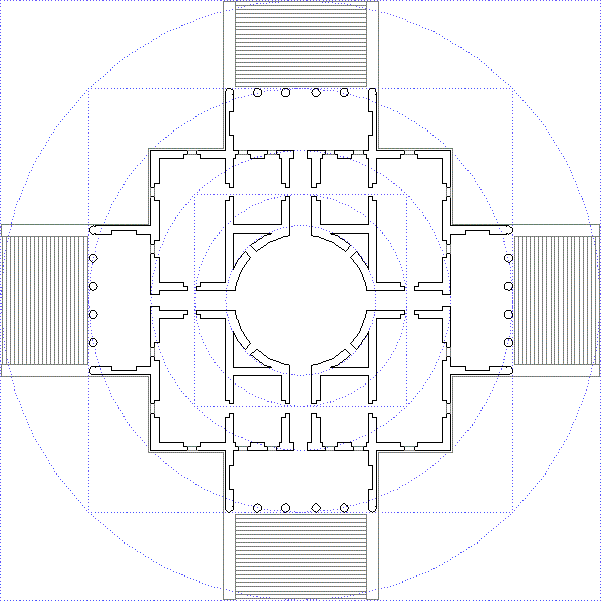
A much more precise reenactment.
Tomorrow I'll be drawing the plan of my own most recent design, from memory.
1954.02.14
1954. Sunday, New York City
Expressing his condolences to Fiske Kimball, whose father has died, Marcel comments: "We are entering the season of our life when the leaves begin to fall rapidly around us."
He thanks Fiske for the "good news" of progress in the work for the Arensberg Collection. Unable to furnish Fiske with the information he needs on Walter Arensberg for the foreward to the catalogue of the collection, Marcel gives a separate list of Arensbergs close friends. Saying that Walter never gave him anything about Dada, Marcel suggests that Fiske consult the volume Dada Painters and Poets edited by Robert Motherwell and he encloses a copy of 391 [no. VII?] in which a poëme en prose by Walter is published.
Ephemerides
|