2025.12.04
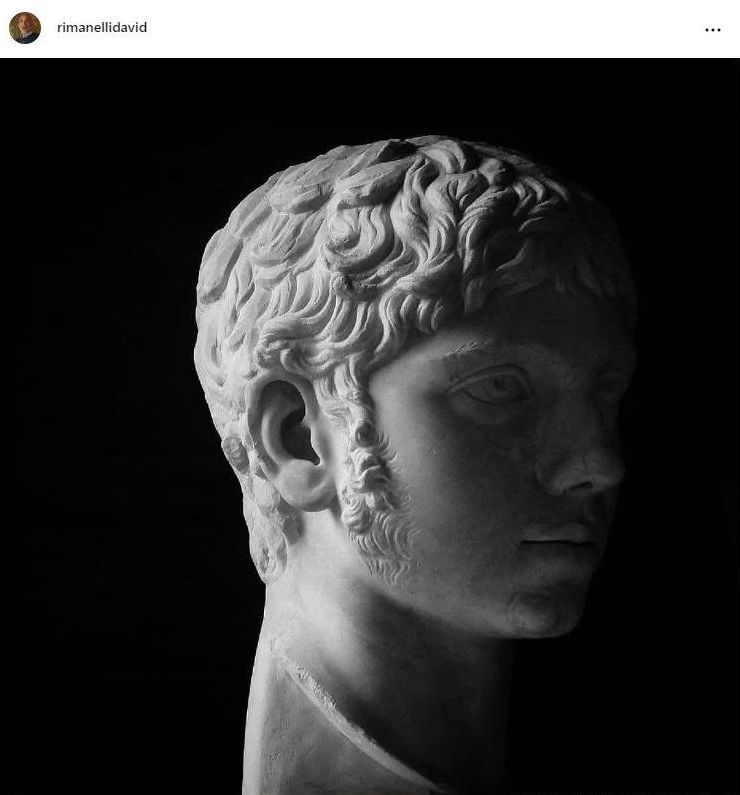
rimanellidavid Elagabalus, penultimate emperor of the Severan dynasty, married as his second wife Aquilia Severa, a union that was deemed quite controversial as she was a Vestal Virgin and sworn by Roman law to celibacy for 30 years. She was discarded within a year for Annia Aurelia Faustina, the widow of a man executed by Elagabalus and a descendant of Marcus Aurelius. But his most notable relationship was with a blond slave, his charioteer Hierocles, whom he referred to as his husband. (According to the “Augustan History,” he also married an athlete from Smyrna named Zoticus in a public ceremony in Rome.) Elagabalus disported himself in inappropriate, "feminine" attire, depilated himself, and painted his face. He sold himself as a prostitute in Roman brothels and taverns but also in the Imperial palace itself. Messalina herself would have blushed at his immodest behavior.
"Finally, he set aside a room in the palace and there committed his indecencies, always standing nude at the door of the room, as the harlots do, and shaking the curtain which hung from gold rings, while in a soft and melting voice he solicited the passers-by. There were, of course, men who had been specially instructed to play their part. For, as in other matters, so in this business, too, he had numerous agents who sought out those who could best please him by their foulness. He would collect money from his patrons and give himself airs over his gains; he would also dispute with his associates in this shameful occupation, claiming that he had more lovers than they and took in more money."
Cassius Dio, "Roman History" LXXX.13 [Loeb, 1927]
The Emperor Elagabalus
218/222 AD; Severan Musei Capitolini, Rome Photo: Gabriele St. Emiliano
451.rhawn.gallery One of my favorite historical figures! His great Sessorian Palace in Rome ultimately became the residence of Helena Augusta, the mother of Constantine, Saint Helena. All that remains of the Sessorian is the great hall that is now Santa Croce in Gerusalemme. ps Helena's finding of the True Cross was an imperial hoax.
2024.12.04
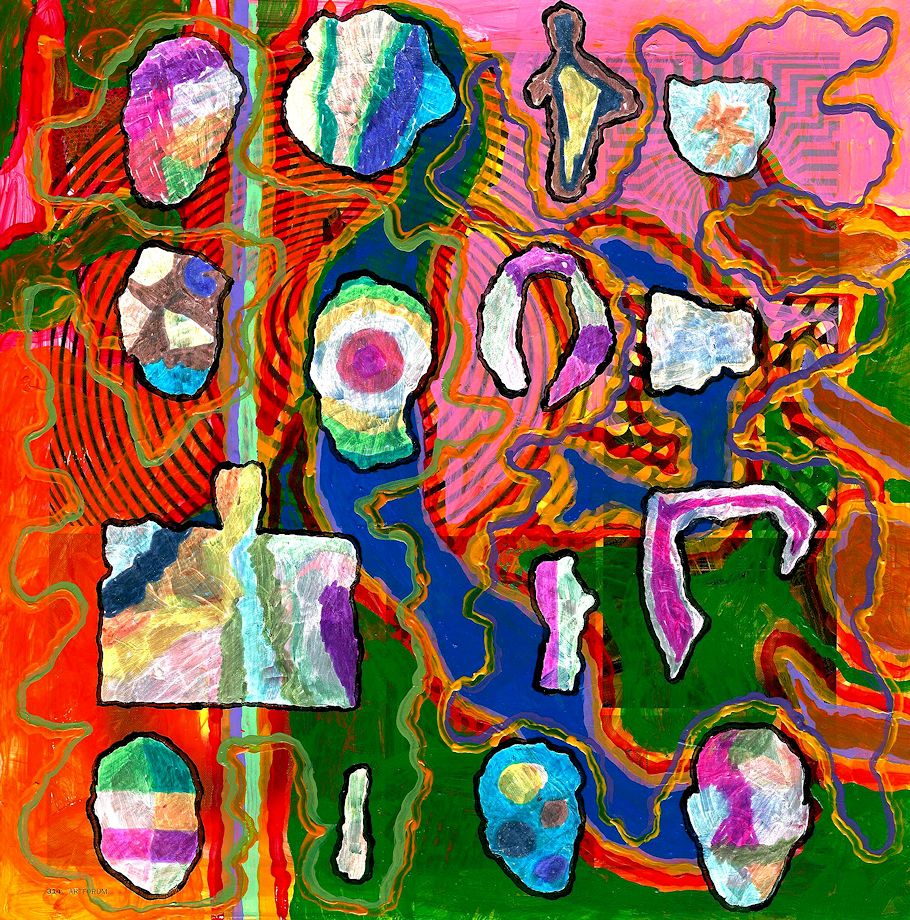
page painting 174
2016.12.04
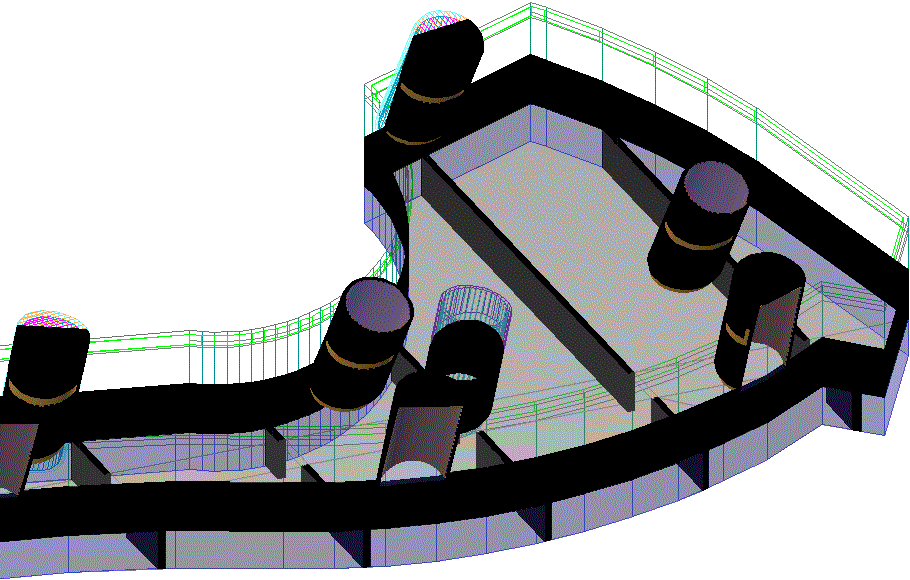
16120401.db GAUA 101 model work
2015.12.04
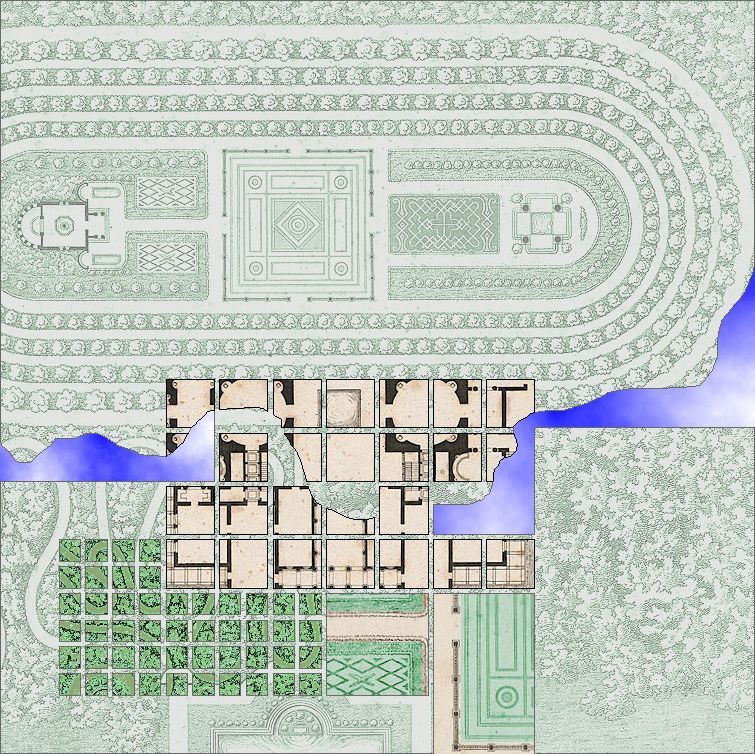
House for Karl Friedrich Schinkel
"Are we human?" Curators Beatriz Colomina and Mark Wigley announce concept for 2016 Istanbul Design Biennial
The conclusion of a discussion here "about the possibility of a virtual architectural biennale" from almost two years ago:
Orhan Ayyüce:
With "set piece" I meant representative pieces of architecture as in drawings, models of buildings already built or designed or under construction/slated. Versus, generation of ideas in architecture and urban design before any of that happens.
Quondam:
I really don't know Wigley, but fourteen years ago, he and I had a mostly private conversation over lunch (we both have a schizophrenic brother), and the next evening I sat next to him at a Zengelis/Gigantis Thankgiving dinner party. Plus we talked about bidding at eBay in the car that was giving me a ride back to my hotel--he was slightly upset by usually being outbid on items he wanted, and I teased him that I got that item. As I'm thinking back to those conversations, it's kind of refreshing how much I'm able to remember about them. I started our first conversation by telling him that (because I knew he too was going to be at the conference) I decided to read something written by him in case I might meet him. I read "Untitled: The Housing of Gender." I told him I had to stop reading it because it was making me uncomfortably question too many things about my own 'housing' and 'gender'. He broadly smiled in agreement because I seem to have gotten exactly what the essay was about. And from there we just started talking about all kinds of stuff.
In terms of set-piece or process, I'd say multiple choice as in:
column A
set-piece
process
column B
fertility
conception
assimilation
metabolism
pregnancy
osmosis
electromagnetism
all-frequency
column C
architecture
urbanism
The setting in the video reminded me of being in Australia--something about the light and the view in the background. Perhaps roughly the same distance from the Equator.
- - - - - - - -
2015.12.04
Note column B comprises the design operations of being human itself.
2002.12.04
ideas
1. the notion of a publication entitled Post-Quondam Architecture which comprises crazy model collisions, etc.
2001.12.04
Piranesi Prison dates, etc.
I don't like having to do this (because it implies that some editor is not really doing their job), but it must be pointed out that Joseph Rykwert made (at least) one factual mistake within The Seduction of Place (2000). On page 150, Rykwert states:
"The attempt to provide a mimetic "condensation" of another place and time is not new. Centuries ago pilgrimages to remote and sacred places were replicated for those who could not afford to leave home. The fourteen [S]tations of the [C]ross, which you may find in any Roman Catholic church, are a miniaturized and atrophied version of the pilgrimage around holy places in Jerusalem."
The above is complete disinformation. The Stations of the Cross do not represent a "pilgrimage around holy places in Jerusalem." The Stations of the Cross are a ritual reenactment of what Christ experienced on the day of His crucifixion.
Interestingly, the example that Rykwert should have put forth is that of Santa Croce in Gerusalemme, the church in Rome built within the Sessorian Palace, the imperial home of Helena Augusta, which today houses Christianity's most valuable relics (of the "Stations of the Cross"). Additionally, Santa Croce (which means Holy Cross) is built upon ground brought back by Helena from Golgotha, site of Christ's crucifixion. Santa Croce is indeed one of Rome's primal pilgrimage churches.
design of war?!?!
Today, 4 December, is the feast of St. Barbara.
The following is the last paragraph from "St. Barbara" in Butler's Lives of the Saints:
"So is told in Caxton's version of the Golden Legend the story of one of the most popular saints of the middle ages. There is, however, considerable doubt of the existence of a virgin martyr called Barbara and it is quite certain that her legend is spurious. There is no mention of her in the early martyrologies, her legend is not older than the seventh century, and her cultus did not spread till the ninth. Various versions differ both as to the time and place of her martyrdom: it is located in Tuscany, Rome, Antioch, Helispolis, and Nicomedia. St. Barbara is one of the Fourteen Holy Helpers and that she is invoked against lightening and fire and, by association, as patroness of gunners, military architects, and miners is attributed to the nature of the fate that overtook her father. The tower represented in her pictures and her directions to the builders of the bath-house have caused her to be regarded as a patroness of architects, builders, and stonemasons; and her prayer before her execution accounts for the belief that she is an especial protectress of those in danger of dying without the sacraments."
When I first read the above almost a year ago, I couldn't help but be struck by the many similarities of Barbara's "story" and some of the occurrences within the actual life of St. Helena. It makes me wonder if Helena's "story" at sometime and in some areas morphed into the legend of St. Barbara. For example, Helena was for many years in "exile" when she was divorced from Constantine's father, there was a great bath in Rome named Therme Heleniana, and St. Helena too is the patroness of miners. In any case, it is interesting how saints, especially those that are not believed to have actually existed, manage to manifest a true "double theater" of belief versus (accepted) reality.
2000.12.04

at the "sacred" tree in Tacony Creek Park
"sacred" wood collected
1961.12.04 Monday Philadelphia
Having traveled with Teeny from New York earlier in the day, at eight-thirty Duchamp is "guest commentator" at one of the "Art Enjoyment Evenings" organized by the Philadelphia Museum of Art. In the Van Pelt Auditorium he talks about Hans Richter's film Dreams that Money can Buy before three sequences from it are screened.
Introducing the sequence directed by Max Ernst, Duchamp says: "Joe the dream-merchant sells to Mr A. the bank clerk (who is full of amorous feelings) the story of 'Desire', in which the vagabond subconscious of a sleeping girl materializes through a soliloquy mixed up with fragments of conventional reality. The figure, enacted by Max Ernst himself, follows the lovers as a sort of super-ego, silently witnessing their emotional irresponsibility..."
After the audience has seen the Ernst, which is followed by Fernand Léger's contribution, "The Girl with the Pre-Fabricated Heart," Duchamp turns to the short sequence "composed" by himself and Richter, entitled "Discs and Nudes descending a Staircase".
"The discs are simple flat designs taken from a series of twelve drawings made in 1934 which I called Rotoreliefs." The one chosen for the film, explains Duchamp, "is a drawing which gives the illusion of a three-dimensional crater, and Richter added a prismatic distortion which multiplies the number of drawings like a kaleidoscope.
"Moving rhythmically across the screen, the Rotoreliefs add to their third dimension the illusion of going down. The accompany the nudes descending the staircase, repeating it several times to give a stroboscopic impression... A detail we also added to emphasize the illusion of a downward motion was the unloading of a coal truck into a cellar, interspersed with the procession of female nudes reminiscent of my painting.
"I was very fortunate," Duchamp adds, "to have the music for my sequence especially written for a prepared piano, by John Cage."
|