2026.07.01
sehr Unbekannt zu mir
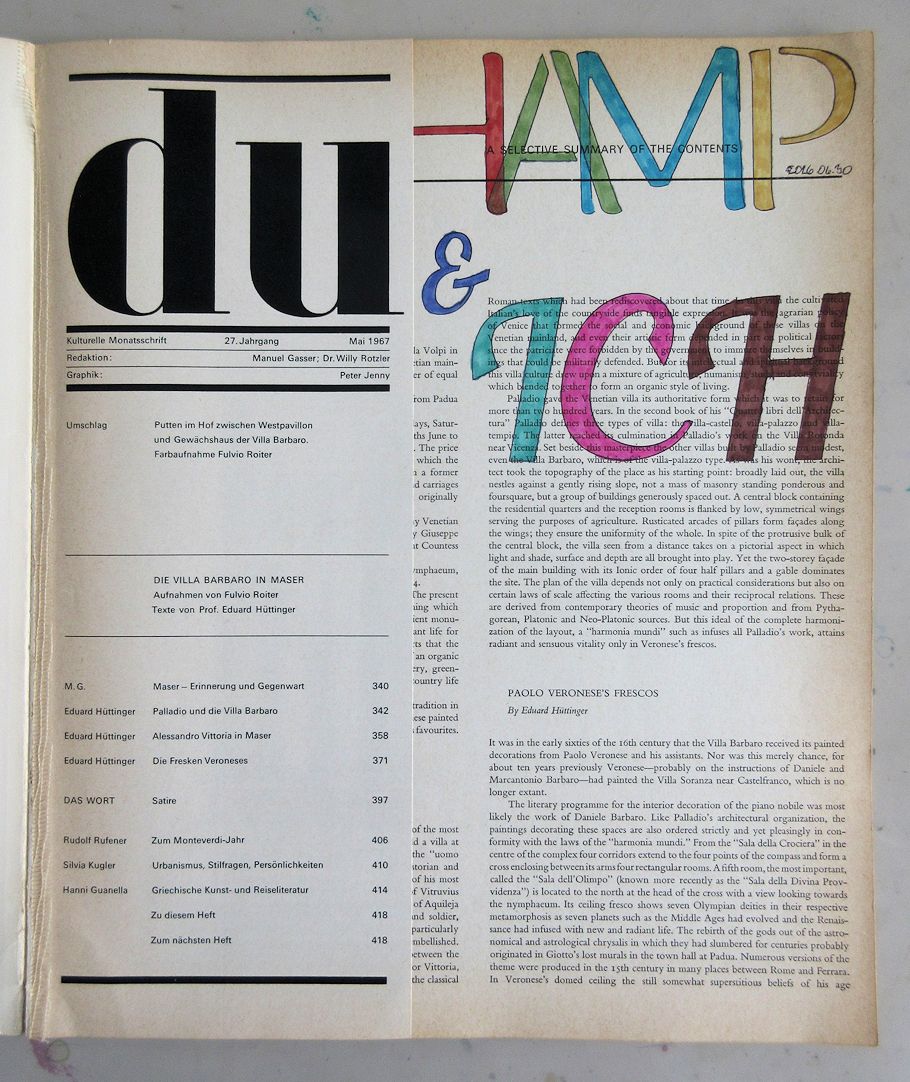
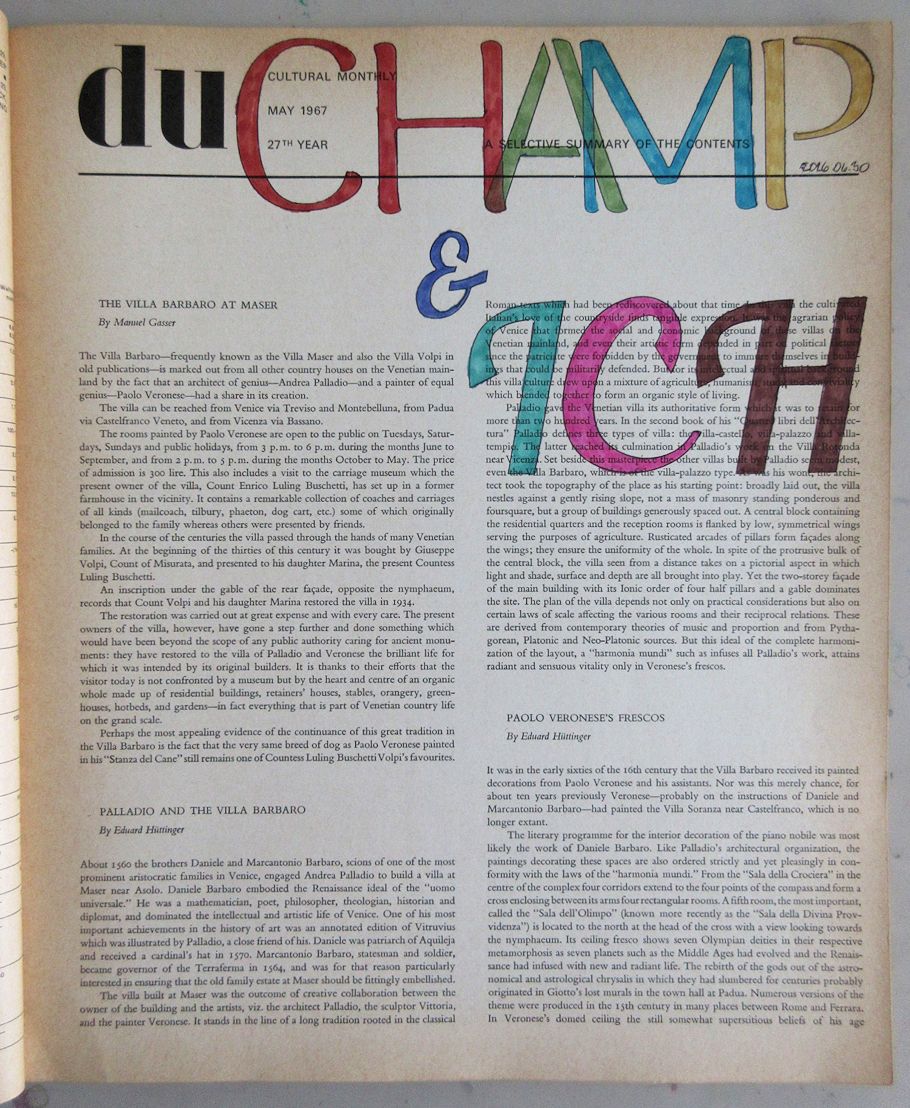
Stephen Lauf Duchamp und Ich 2026.06.30
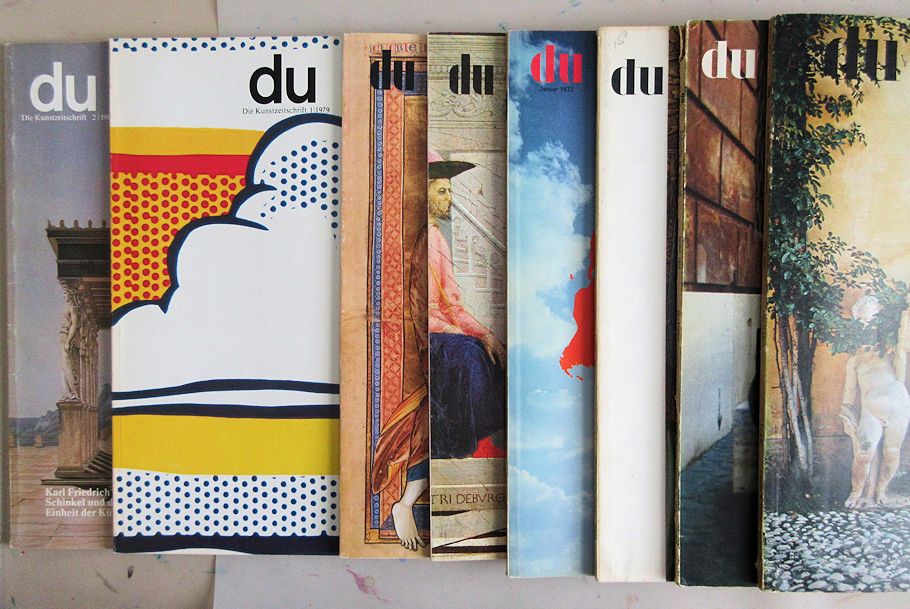 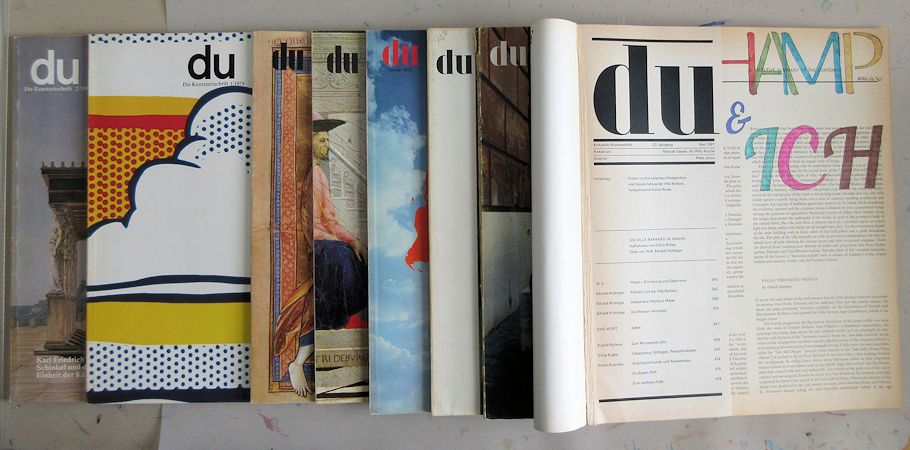
the makings of incompletely new post-ephemeral elegant game magazines? we'll see.
2025.07.01
451 Rhawn Gallery
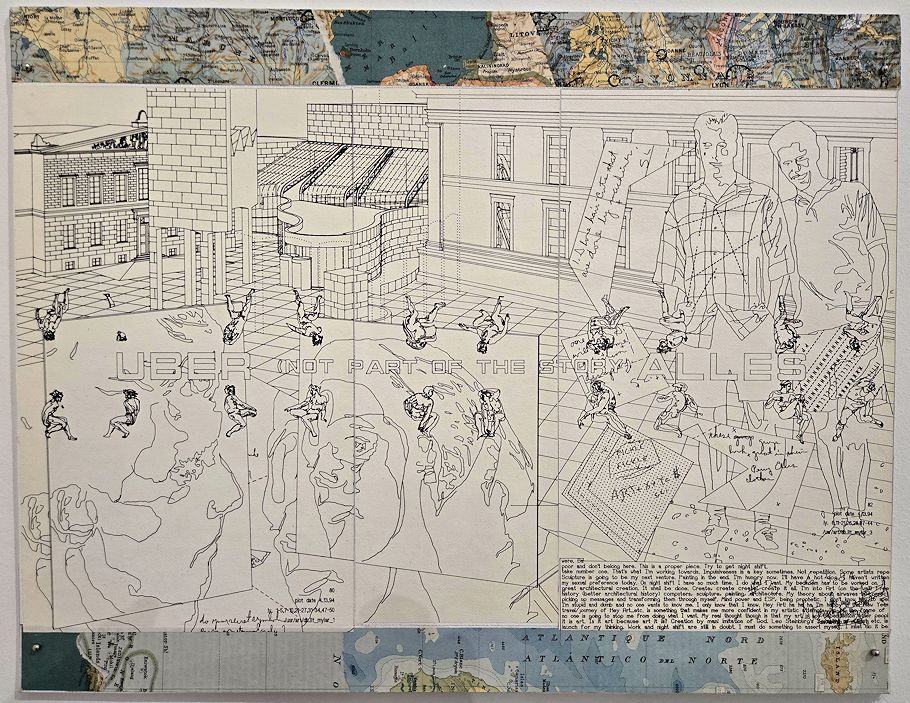
[untitled: still incomplete]
2017.07.01
zero six one
2009.07.01
what is the difference between paradise & utopia?
...I found your initial query thought provoking in that, as you say, one doesn't really hear about architects designing (a) paradise.
When PG,UB suggested research into landscape design of the Middle Eastern and Islamic world, I began to think about the Alhambra--a fortress/palace/city as paradise.
Regarding heterotopia, for some reason, I began to think of the novel Platform--notions of sex tourism within 'paradise'. Also got out my Foucault Reader and read "Space, Knowledge and Power" where Foucault says a few things about ancient Roman baths and their eventual demise throughout Europe--not exactly places of paradise, but public, social places centered around activities of pleasure [and relaxation].
You say you are planning to design a paradise. Care to share a little more about that?
2004.07.01
Modern Trajectory
Why not compose a modern trajectory based on individual buildings/designs and events (such as building expositions, publications, schools, symposiums, etc.) entwined with historical events, instead of dealing with architects themselves as a datum?
Is the course on architecture or is it on architects?
A Venturi and Rauch building of the 1960s, for example, is not the same as a Venturi, Scott Brown & Associates building of now-a-days. The same goes for Gehry's career trajectory. An early Mies building is not the same as a late Mies building (although most late Mies buildings are just like each other). Note what building design Kahn was working on while Wright was designing Beth Sholom Synagogue.
A chronological trajectory of buildings/designs will be much more informative than a more or less speculative list of what architect may have succeeded or followed what other architect.
Modern Trajectory
MoMA also had a Japanese Design exhibition in 1954.
The Language of Post-Modern Architecture was first published in 1977.
1966: Complexity and Contradiction in Architecture - Venturi
1966: Architecture of the City - Rossi
Not only were Le Corbusier's executed works always news-worthy, but each consecutive publication of his Complete Works lead to widespread (i.e., global) emulation throughout the field of architecture.
The necessity of rebuilding Europe after W.W.II lead to an enormous proliferation of modern design.
1925: Towards a New Architecture - Le Corbusier.
The coeval-ness of Art Deco and Esprit Nouveau.
The works of Stirling and Gowen as the ultimate manifestation of Russian Constructivism.
Stalinist Architecture as the ultimate manifestation of Piranesi's Ancient Roman fantasies.
2003.07.01
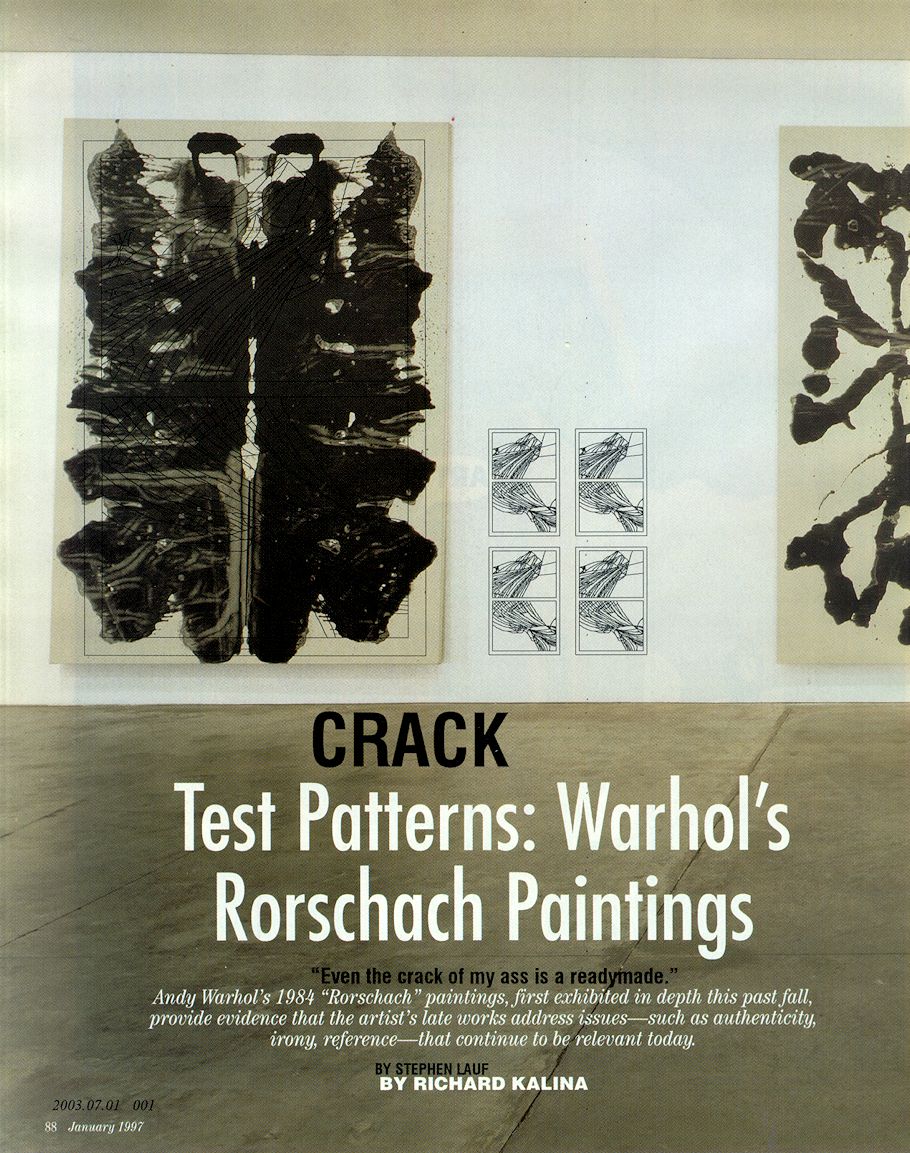
Crack Scam 001
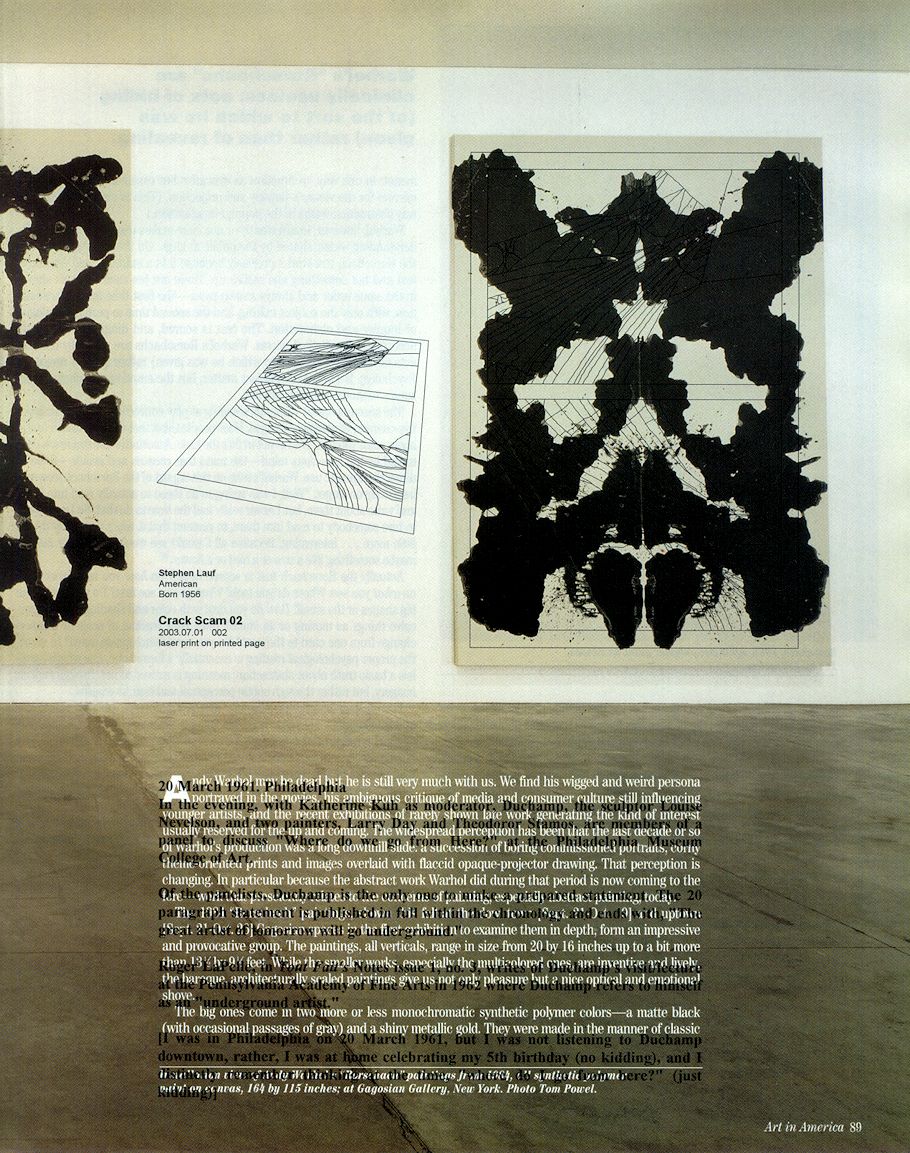
Crack Scam 002
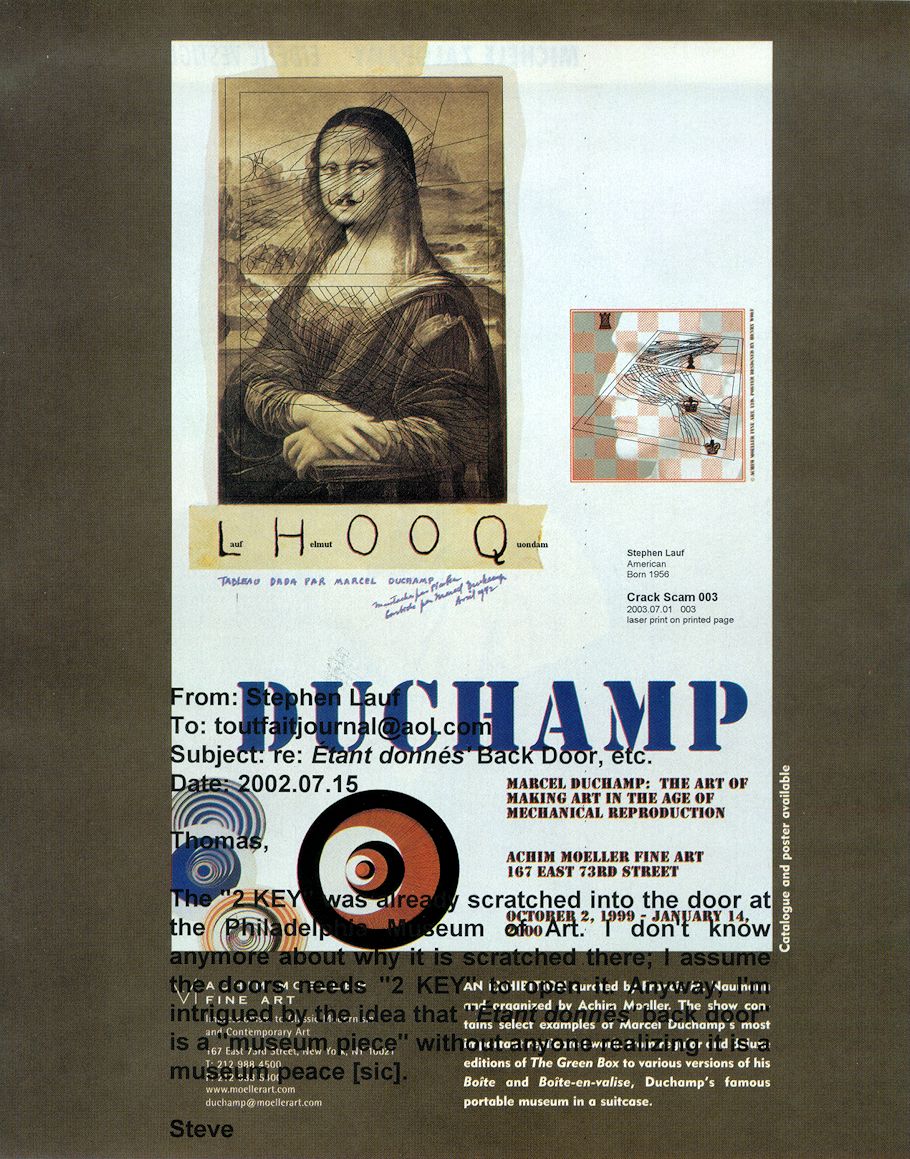
Crack Scam 003

Stephen Lauf, Étant donnés' back door 2003.07.01
An artistic investigation of Marcel Duchamp's work in situ, and hence a manifestation of the work's influence. A PC formatted compact disc documentation, 295 html pages, 665 images. Each CD is signed and numbered from an edition of 100.
Artist's intention: "I hope that at some points this work cracks you up."
1912.07.01
1912. Monday, Munich
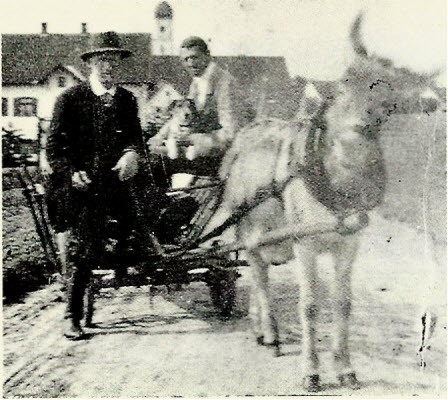
Max Bergmann, who urged Duchamp to visit him in Munich, no longer has his studio at 59 Georgenstrasse by the Akademie, but has recently moved to Haimhausen, about 20 kilometres north of the city. With his friend Ludwig Bock, also a painter, he has taken a house near the church in Sonnenstrasse, where they plan to offer open-air classes in landscape, figure and animal painting. Bergmann, with his cart drawn by Elsa the donkey, can meet Duchamp from the train at Lohhof.
In the gentle landscape there is much to explore: the tiny village chapel in the woods dedicated to the Virgin; also Mariabrunn, an isolated source marked only by a church and a small brewery supplied by the precious fountain, which has a simple beer garden shaded by trees--an attractive objective for any promenade. On their way to the Isar they would pass Neufahrn where, according to myth, the place to build the church was directed by the Heilige Kümmernis. Can the presence here of Wilgeforte have escaped Duchamp? A popular saint in the Pays-de-Caux in Normandy, mirrored by the cult of the Heilige Kümmernis in Bavaria, Wilgeforte was the virgin princess and reluctant bride who became miraculously bearded when, like Christ,
she was stripped bare by her executioners.
1.7.1912
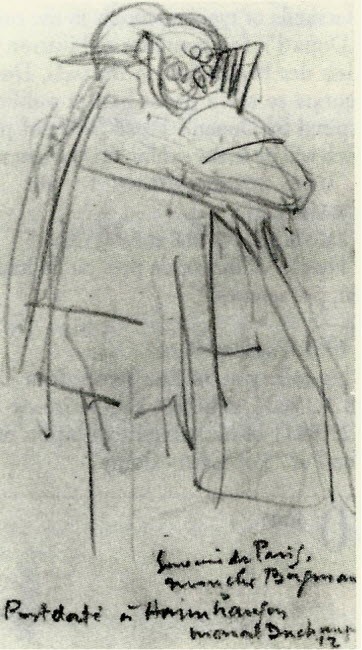
On such a visit to Haimhausen, in friendly souvenir of the time they spent together in Paris [29.4.1910], Duchamp dedicates for Bergmann a drawing he made of a couple embracing: the young woman, her hair coiled over her ears, is Jeanne Serre [16.4.1910].
But today, ten days after his arrival, Duchamp rents a small furnished room from August Gress, a young machine-operator of his own age with an apartment on the second floor at 65 Barerstrasse. A short walk from the Alte Pinakothek, Duchamp's room is in the centre of Schwabing which, with the university and the Akademie nearby, is second home to Bergmann and his friends. Almost opposite in Blütenstrasse lives the Romanian artist Lascar Vorel (mentioned with Gress in a note by Duchamp), whose girlfriend, the talented Mucki Bergé,
sings at the Alter Simpl, 37 Türkenstrasse.
On the corner of Schellingstrasse and Barerstrasse stands the Schelling-Salon, a large cafe offering billiards and chess, where Duchamp is certainly fascinated by a giant chessboard on the ceiling of an alcove, commemorating a game played in London during the international tournament in 1851 between Adolf Anderssen and Kieseritzky.
Ephemerides
|