2025.12.13
Here are some passages from The Ready-made Thief which I read last night:
"A man I respect very much once said that 'the great artist of tomorrow will go underground.'"
"The same man said that when a million people look at a painting, they change it. Just by looking."
"Duchamp thought that the viewer completed a work of art. That something sparked between the viewer and the work, giving it its meaning. So whatever it is for you is what it is. In your universe. In my universe it might be something different. So in a sense we're looking at two different works right now. As far as what he meant it to be, Duchamp was never very forthcoming about his intent."
As they fucked against the old wooden door, she [Lee] felt a splinter go into her back [lol], but the pain of it was subsumed in the moment. There was nothing else. The guards, the paintings and sculptures, the adrenaline of the trespass, the aura, whatever the hell that was--all of it was subsumed. She never disappeared so completely. (Rose, 99, 106, 107)
20 March 1961. Monday, Philadelphia
In the evening, with Katherine Kuh as moderator, Duchamp, the sculptor Louise Nevelson, and two painters, Larry Day and Theodoros Stamos, are members of a panel to discuss "Where do we go from Here?" at the Philadelphia Museum College of Art.
Of the panelists, Duchamp is the only one to make a brief statement. (Ephemerides)
Duchamp indeed ended his brief statement with the sentence, "The great artist of tomorrow will go underground."
I, too, was in Philadelphia 20 March 1961, and I'm pretty sure that's when I blew out five birthday-cake-candles after making a big wish (which may have come true, even).
"The poor Mona Lisa is gone, because no matter how wonderful her smile may be, it’s been looked at so much that the smile has disappeared. I believe that when a million people look at a painting, they change the thing by looking alone." (Duchamp in 1964 interviews with Calvin Tomkins)
I want to say, "context matters," but it's weird how Duchamp's comment here already kind of says that.
Let us consider two important factors, the two poles of the creation of art: the artist on one hand, and on the other the spectator who later becomes the posterity. It is with these words that Duchamp began one of the rare academic lectures, titled "The Creative Act," that he ever agreed to give. The creative process is thus not stopped at the chance relations that cause the word "art" to arise from the meeting of an object and an author. After all, the public represents half of the matter; art is also made through the admiration one has for it; the masterpiece is declared in the final analysis by the spectator. In short, it's the viewers who make the pictures. Duchamp is very clear in the evaluation of their responsibility: art is a product of two poles; there's the pole of the one who makes the work and the pole of the one who looks at it. I give the latter as much importance as the one who makes it. (de Duve, 401)
Hopefully, eventually, I will address "The Creative Act" and the overall notion of the viewer completing the work of art, but, right now, I'm wondering if Étant donnés has ever been "completed" by two viewers actually performing sexual intercourse against its door. Who knows, right?
A "truth is stranger than fiction" story:
On 5 November 2000, I took a digital snapshot of Duchamp's Chocolate Grinder (No. 1), more specifically, I took a picture of my own reflection within the glass frame enclosing the art work. The painting itself was hanging on one of the wall of the Duchamp Gallery of the then Philadelphia Museum of Art. I subsequently published this image (along with the many other images I've taken in the Duchamp Gallery) at quondam.com and museumpeace.com.
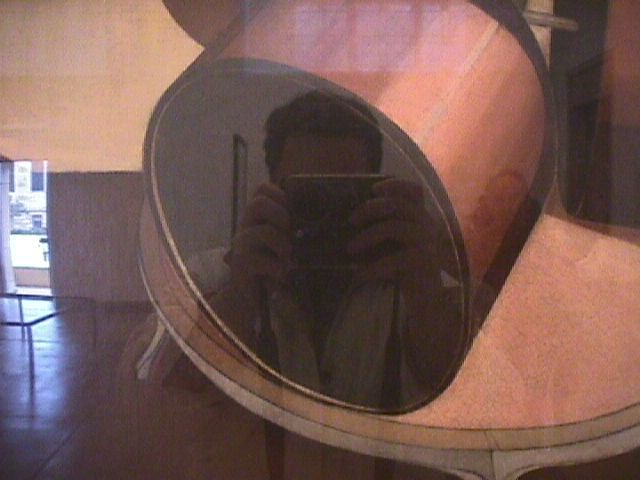
I also, subsequently, more or less completely forgot about this image.
On 22 April 2023, I received an email that included the following: "At the [GES-2 House of Culture, Moscow] exhibition we would like to reproduce the image of the male figure with which you describe the mechanism of The Timepiece of Humanity and present an audio version of your text. This image together with the architecture of the exhibition will be able to better present the different projects of the artists and to unify them conceptually." Signed Yura Plokhov.
I had no knowledge of Yura Plokhov, etc. before this.
On 25 April 2023, I receive another email that includes this: "I am sending you a series of works that my wife [Ekaterina Plokhov] completed last year titled "The Philadelphia School".
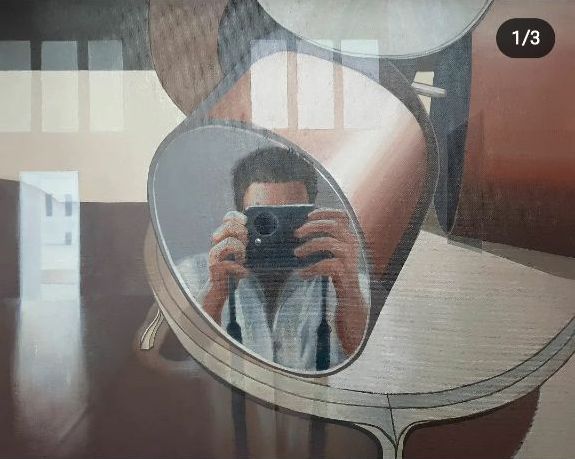
Again, I had no knowledge of Ekaterina Plokhov before this either,
however,
Did I complete Duchamp's work?
Did Ekaterina complete my work?
Are we all now completing Ekaterina's work?
Again, again, again, you do the math.
2024.12.13
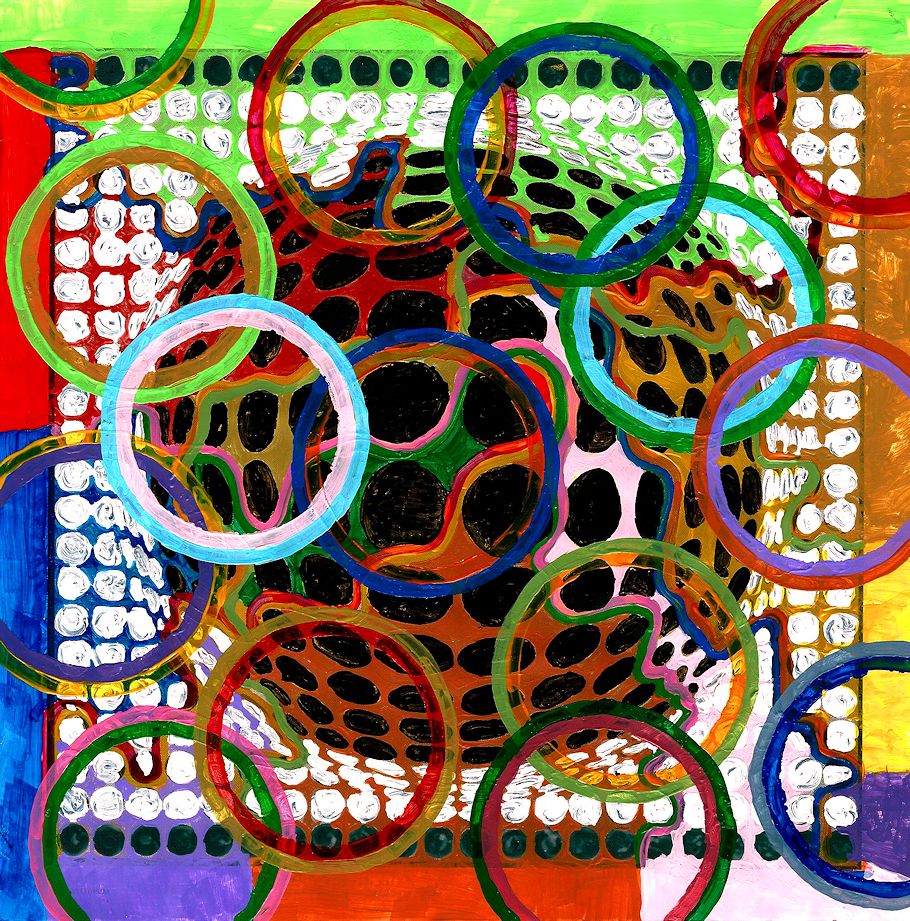
page painting 181
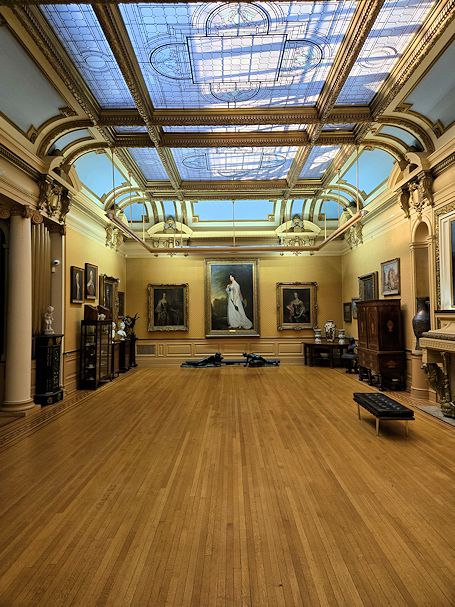 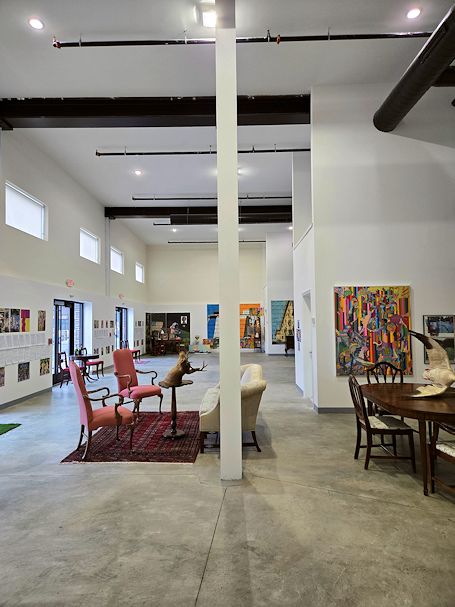
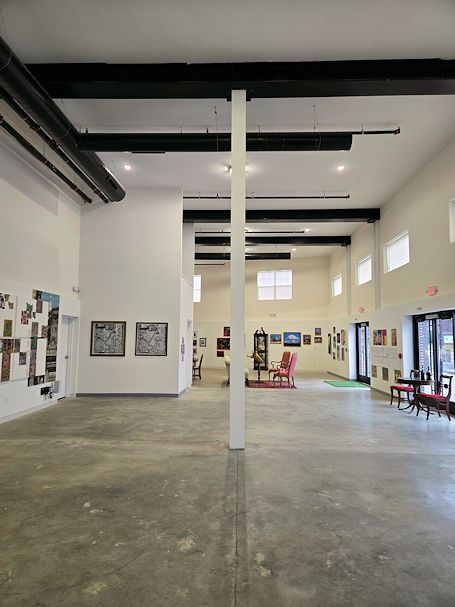 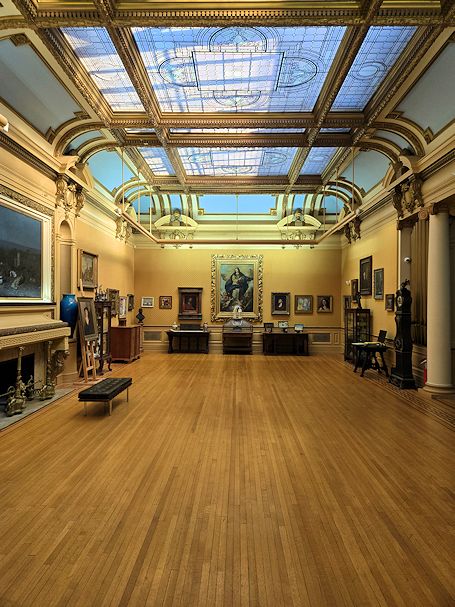
Glen Foerd Art Gallery/451 Rhawn Gallery -- the two almost identically sized art galleries of Northeast Philadelphia
2019.12.13
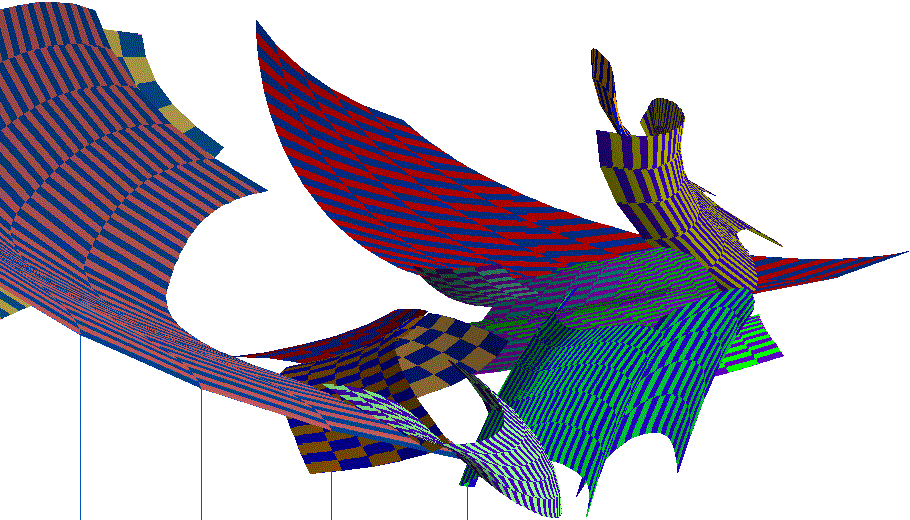
19121301.db 30th Street Station Railyard REMs wireframe opaque
2012.12.13
13 December
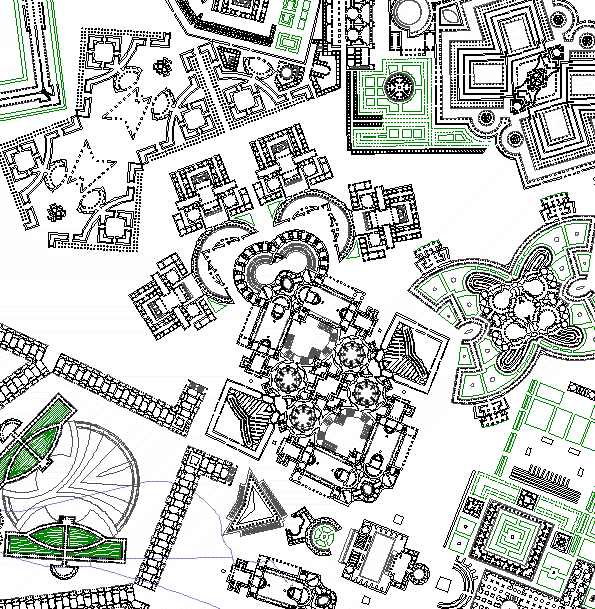
Seeing a couple of images I took 12 years ago today...
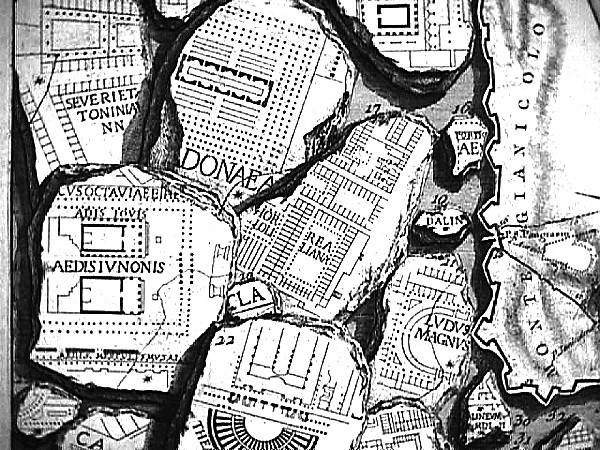
...reminds me of this.
13 December
Fourteen cows were busy grazing at the farm's highest elevation, right next to the fence. I noticed they had names on their numbered ear-tags--Daphne, Kikki, and Tootsie were close enough for me to read. And then, on the last leg of my walk down in the woods along the creek, about 50 yards in front of me, a small herd of deer sprang up from the creek and started sprinting up the hill toward the farm. As I got closer, four of them stopped half way up and turned around and watched me as I walked by. I whistled at them, clapped at them, but they just stood there and watched me. I thought I saw more than four though, and then I saw two and then one more little ones timidly catching up with the bigger ones. White tails again.
If I recall correctly, the Schlittenfahrt bathroom was a reenactment of the Duchamp gallery at the Philadelphia Museum of Art. You know, a urinal, peep-holes, a bride stripped bare, broken glass even, all the things you want in a bathroom. Wolfhilde's doin' just fine. She's taking up yodeling in the nude as she descends staircases. And yes, she has now hired me to design several dozen staircases for her. Gott sei Dank!
2006.12.13
Who killed Talkback?
Meanwhile, I'm writing a book on artforum/talkback. It's entitled Letters from Pussies Galore.
Who killed Talkback?
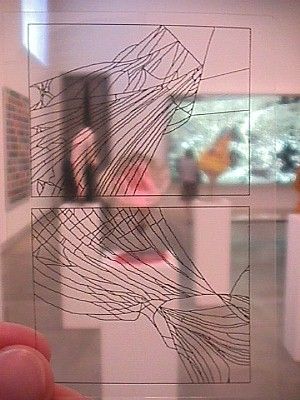 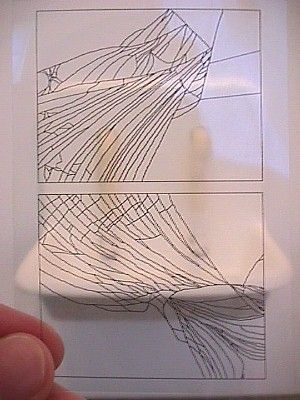 
How's that book on Duchamp coming along? Are you busy as a Beirut bricklayer? Or are you just laying around waiting for your gynecologist to give you the thumbs up?
2003.12.13
Which Acropolis do you prefer?
The Acropolis as used by the ancient Greeks?
The Acropolis as used by the ancient Romans?
The Acropolis when the Parthenon was used as a Christian Church dedicated to Mary?
The Acropolis when the Turks used the Parthenon as a munitions magazine (hence the 17th century explosion that pretty much wrecked the place--as reenacted at NYC 11 September 2001?)?
The Acropolis as mass tourist destination with the Parthenon ruins slowly being further destroyed by air-pollution?
The Acropolis as urban viewing platform as reenacted at Philadelphia's Fairmount (site of the Philadelphia Museum of Art).
Multiple choice, I'm sure.
2001.12.13
Re: egoscrapers
Try first watching The Ruling Class and then watch The Belly of an Architect. The former most entertainingly depicts the double theater of freedom and control, while the latter architecturally (and somewhat boringly) depicts the double theater of delusion and grandeur (or is that what The Ruling Class depicts, and vice versa?).
Be on the look-out for the Electromagnetic Messiah is The Ruling Class--he's a pure joy. And then, in The Belly of an Architect, spy how Boullée is nakedly reduced to the phallacy of it all.
ps
Allen's Deconstructing Harry is likewise great double theater, as is the sad 'reality' of The Legend of Rita. Now it's time to watch Mary, Queen of Scots. Or should it next be Women in the Verge of a Nervous Breakdown?
2000.12.13
aesthetics and imagination
"It is common place to say that the eighteenth-century marks a turning point in the history of aesthetics. M. H. Abrams (1953) has shown how this was the period when the predominant metaphor of the mind as a mirror reflecting external reality began to give way to that of the mind as a lamp which radiates its own inner light onto the object it perceives. The artist is no longer seen as a craftsman-like imitator of nature, but as an inspired genius who brings new worlds into being, spontaneously generating original creations out of the depth of his own mind."
from the editor's introduction to Cocking's Imagination, p. vii.
As we begin the 21st century, is the "predominant metaphor of the [artistic] mind" still a "lamp which radiates its own inner light onto the object it perceives?"
1994.12.13
metabolic concurrence
…one unique factor of metabolism is that it is concurrent with both assimilation and osmosis, although all three, metabolism, assimilation and osmosis, are never concurrent. In other words, metabolism is first concurrent with assimilation, and after a 500 year period of acting alone, metabolism is then concurrent with osmosis.
heightened plurality and metabolism yet to come
...over the next 1200 years, ...the height of plurality is still yet to come. Over the next few centuries, the present will actually pass through more organs than it presently does, and will actually climax at the most organs at about 2300/2400 AD. Our present is just the beginning of plurality. The major/upper organs of the digestive system will become the dominant organs in the "plane of the present."
In general terms, the population will continue to increase, metabolism will become more the way things work, the plurality of organs (and perhaps then organizations) will become more evident, and what will by then by an over 2000 year tradition--assimilation--will be gradually, but evidently, leaving the picture.
The new tradition will be made up of a well defined plurality and a metabolism based operating system or imagination. There may also be a strong sense of anticipation for the coming second birth. The anticipation for the second birth will also be an anticipation for a whole new order.
1962.12.13
13 December 1962. Thursday, New York City
The Duchamps send a message of sympathy to Richard Hamilton, whose wife Terry died in a car accident on 6 November.
*
In the evening the Duchamps attend a Pop Art panel discussion at the Museum of Modern Art, which Teeny finds "very spicy".
Ephemerides
|