2025.12.12
Duchamp was 59 years old when he commenced working on Étant donnés in 1946, and 79 years old when he stopped working on Étant donnés in 1966. I was 59 years old in 2015.
Last night, I commenced reading The Ready-made Thief, and, to my surprise, Typo/Topography of Marcel Duchamp's Large Glass is the novel's frontispiece.
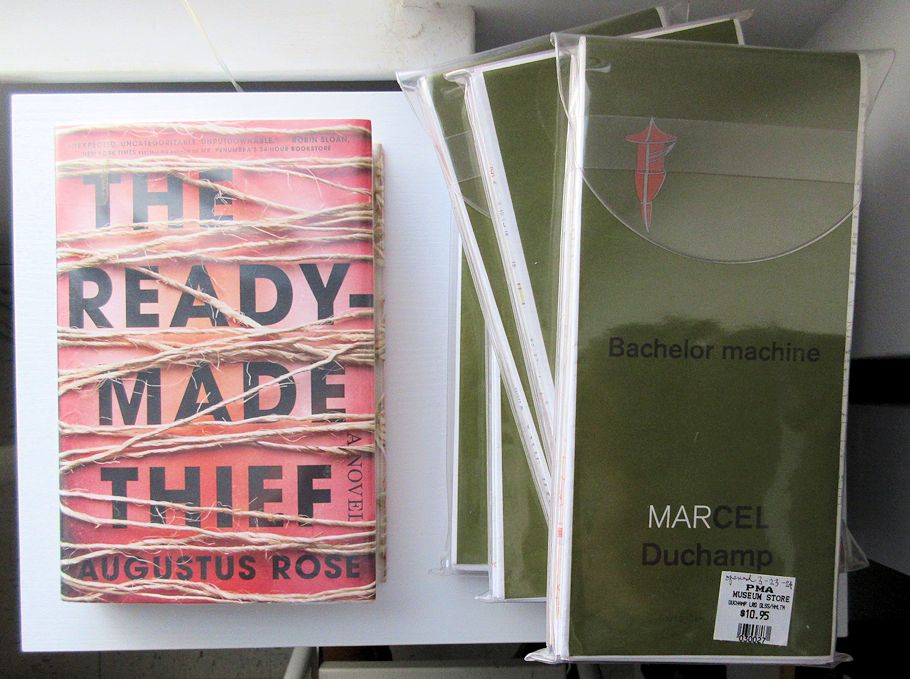 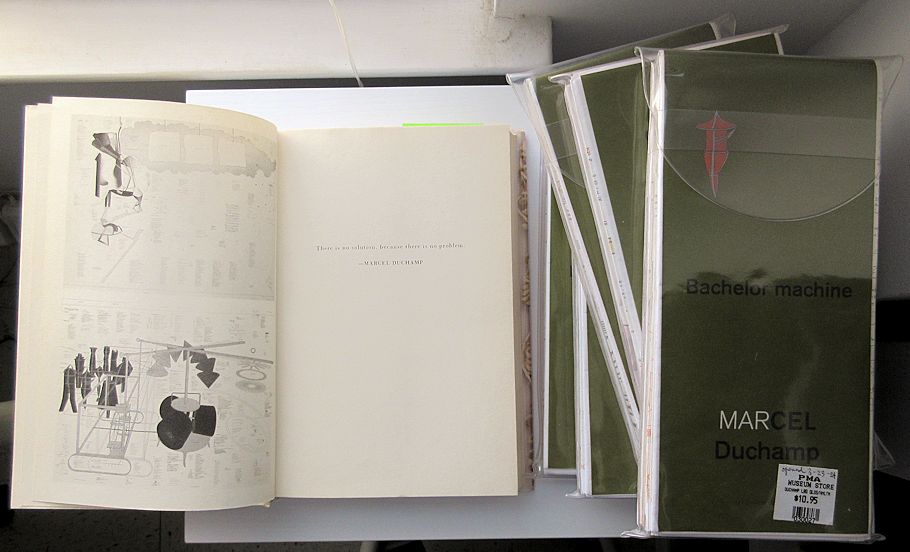
And not that long ago at 451 Rhawn Gallery...
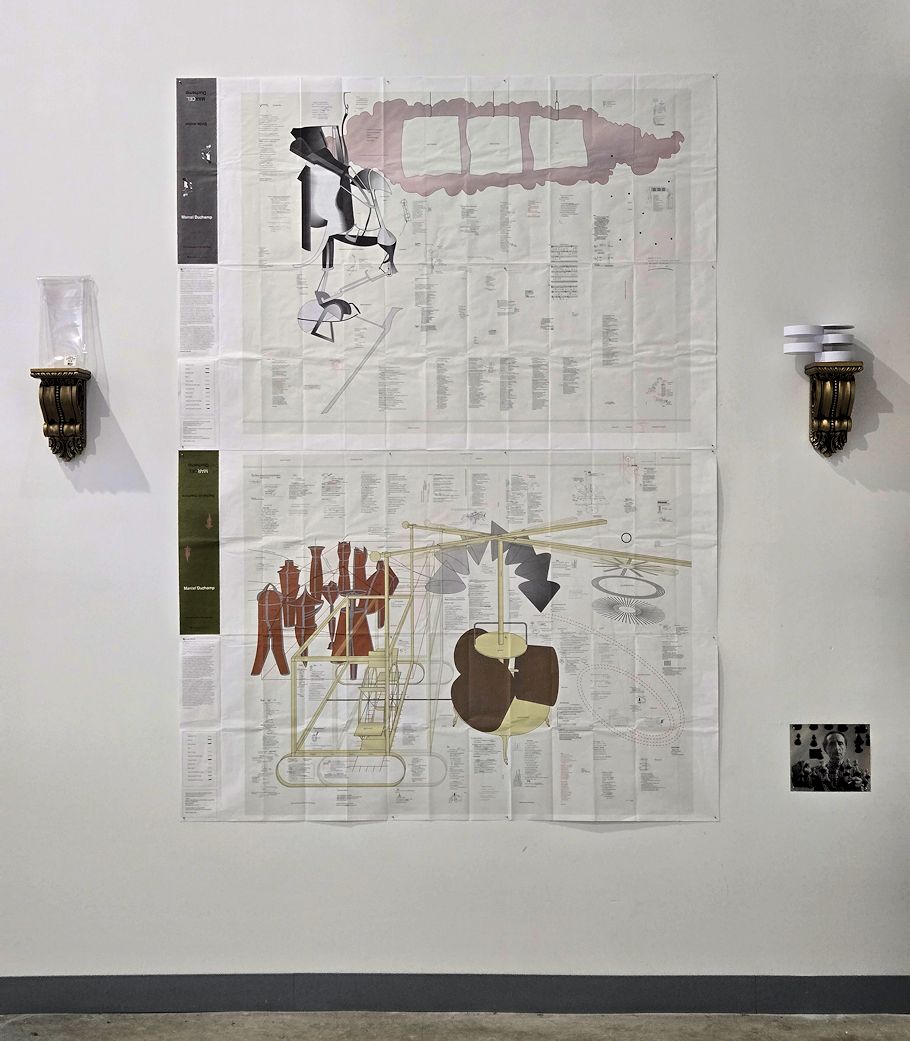
"I wonder if this is on exhibit anywhere else in the world right now."
2024.12.12
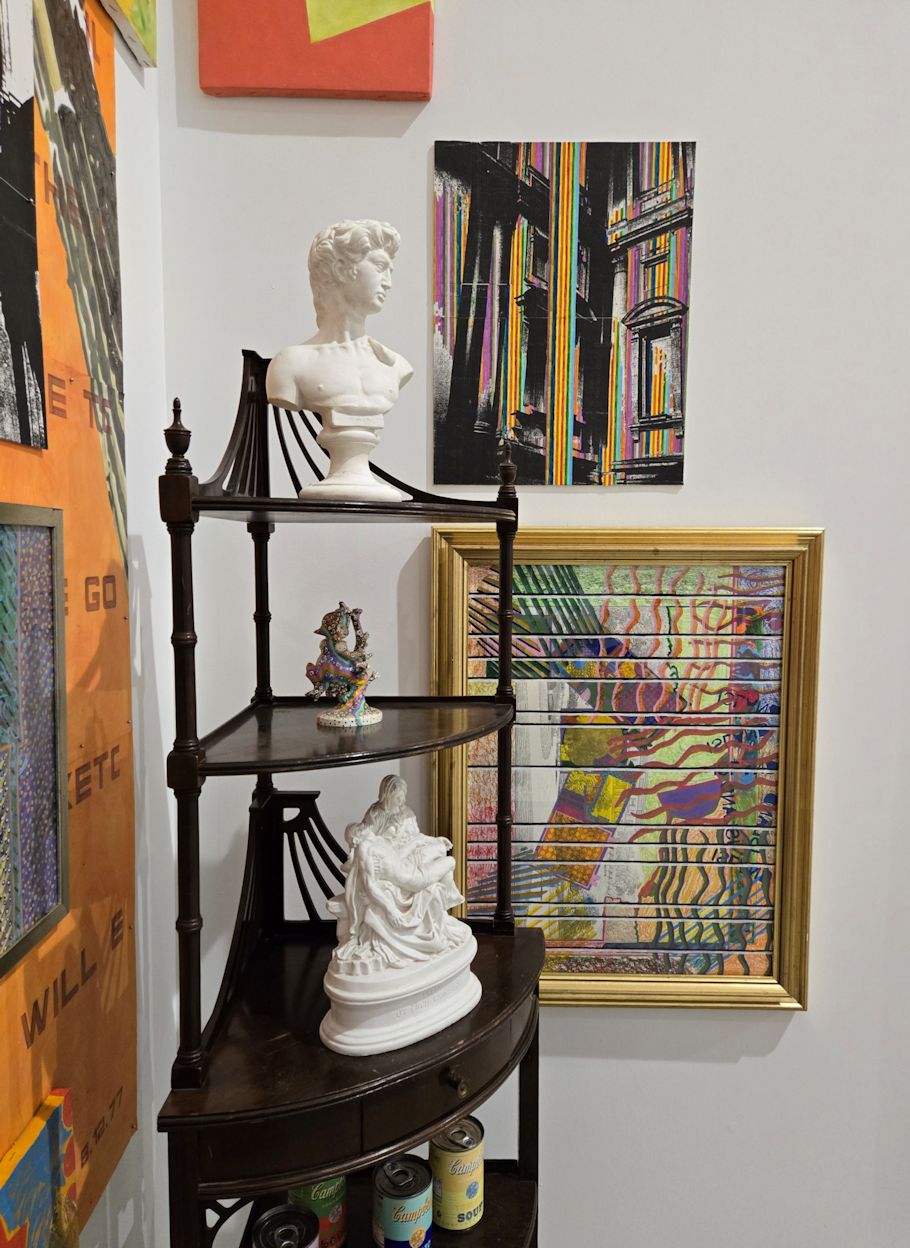
451 Rhawn Gallery
ps 2020.12.12
2012.06.01 13:16
Re: What's Rachel been reading
Hi Tony,
Thanks for the heads-up, but there really isn't anything I can do about it. Besides Museumpeace and Quondam, I made 'news' of Étant donnés' back door at the online Marcel Duchamp bulletin board (2002) and at artforum.com/talkback (2003), where I also commented on Rachel Harrison's work. I don't think anyone within the art world (or general public for that matter) would be aware of the back door if I hadn't publicized its existence via the internet 10 years ago.
I understand completely about the void you feel since your Dad's passing. I'm finding that its just like they say--only time will heal that.
I slowly but surely getting things done within the house, and I foresee being mostly done by the end of October--there's going to be a lot I can't do once the central air-conditioning is running all day.
Just give me a call whenever you'd like to get together again.
Steve
ps 2020.12.12
I'm now thinking that 'Kiss My Abstract' at artforum/talkback was actually Rachel Harrison, just like 'DuChamp' was actually T. J. Demos.
2017.12.12
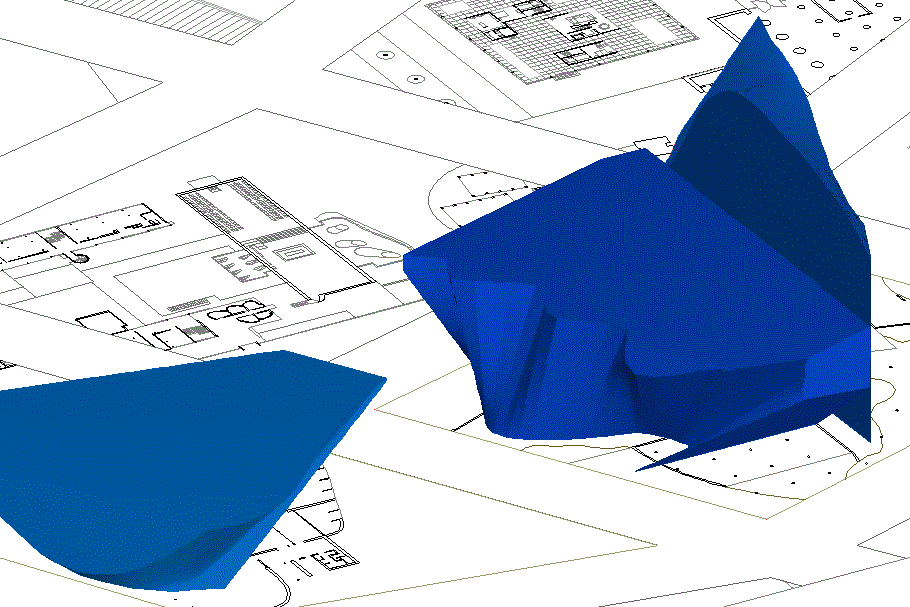
17121203.db surface models cropped IQ63s16 plans
2016.12.12
BIG proposes massive, gridded development for the LA Arts District
You mean Archigram's Plug-In-City's radical social implications that never materialized because there was never anybody to pay for it?
Archigram's projects/design would only be radical if they actually happened.
2007.12.12
Farmadelphia
"Sell" much of North Philadelphia back to the Lenni-Lenape, who could open a few casinos, and sell the rest of "their" land to Mexico on the condition that Mexico use the land as farms, hence employing and giving legal residence to their own citizens who actually know all the work involved with farming. Call it de-colonialization.
Let's be contemporarily honest, isn't that close to what's already happening anyway?
Farmadelphia
There's a large field up on a plateau within Tacony Creek Park which may well have been Lenni-Lenape farmland, as there was a Lenni-Lenape camp just down stream.
Fairmount Park was lots of farmland.
Where I'm sitting right now was a farm until 1973, and I suspect the Lenni-Lenape farmed here as well.

2003.12.12
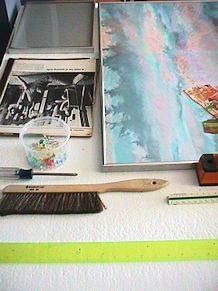
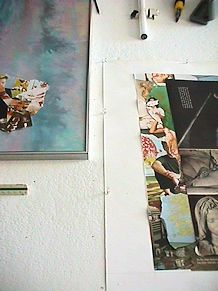
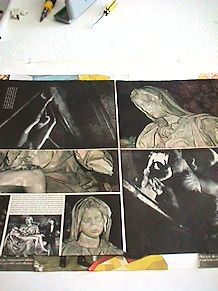
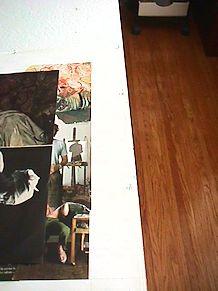
quasi studio
2002.12.12
Re: Seagram's Art & Architecture
[Just last week I learned t]he Widener Collection that is now a big part of the National Gallery, Washington DC, was first amassed in Philadelphia. Before going to Washington, the Widener Collection (including several Rembrandts and even a Vermeer) was in Lynnewood Hall, the Widener Estate, now an enormous abandoned mansion in Elkins Park, PA (about 3 minutes by car from Wright's Beth Sholom Synagogue and 12 minutes from where I'm now sitting--easily the sister to Whitemarsh Hall/Stotesbury Mansion, same architect). Had this collection stayed in Philadelphia at the Philadelphia Museum of Art, no doubt I would now be well acquainted with a lot more master art works. Am I going to be a cry-baby like Lambert, Johnson and Stern? Don't count on it.
2000.12.12
..... language [and innuendo?]
The current discussion on architectural language reminds me of a small exhibit at Quondam online earlier this year--innuendo. In a general sense, the display deals with the 'language' and meaning of architectural planimetric forms, while specifically the display deals with the 'master key' that unlocks the long held mysteriousness of Piranesi's Ichnographia Campus Martius (i.e., the large plan of the Fields of Mars). And in hyper-contextual terms, the display refers to the two rapes that generated Rome: the rape of the Vestal Virgin Rhea Silvia by the god Mars, which in turn produced Romulus and Remus, and then the rape of the Sabine women, an attack planned by Romulus in order to further populate his newly founded namesake urbs. That's rape, then rape reenacted, then Eternal City! What better way to institute a 'place' then with the notion "like father, like son."
1995.12.12
link between Body, Imagination and Architecture and The Timepiece of Humanity
The book will follow the imaginative processes, starting with assimilation and ending with osmosis and electro-magnetism. Fertility and frequency should be discussed as well, but they will not be covered as extensively as the other processes.
...assimilation and metabolism in terms of the Renaissance, the architecture of Michelangelo, and the Baroque...
Like The Timepiece of Humanity, Body, Imagination and Architecture will juggle the connection between specific times and specific parts of the body. There are buildings and designs. however, that fall outside of the strict timeframe, and this issue will be addressed.
initial outline of chapters
1. Introduction
2a. The Renaissance: Assimilation and Architecture
2b. Michelangelo: the First Metabolist
2c. The Baroque and the Enlightenment: Assimilation and Metabolism Together
3. The Metabolization of History I--Learning from Piranesi’s Campo Marzio
4. The Metaboization of History II--the Architecture of K. F. Schinkel
5. Purism as Ultimate Assimilation
6. Towards a Metabolic Architecture
7. Osmosis and Electro-Magnetism: an Outside Inside Architecture
...the (as yet unmentioned) distinction between the profane modes of the imagination versus the sacred modes of the imagination. The sacred and profane division may become the overriding issue.
|