2026.03.05
stranger-then-fiction surprise in the second big box

A stand-alone page among other stand-out items all out-of-sync with the rest of the (typical) material in the box. Epic Battles of the Chessboard?! Of course I immediately thought of Duchamp, but Otto indeed was a chess fanatic in 1972, especially around the Bobby Fischer vs. Boris Spassky "Match of the Century" July 11 to August 31, 1972. I vividly remember my then 19 year old brother reading over a dozen (and more) chess books from the Free Library that summer. That was a full four years before Otto 'snapped' into schizophrenia mid-summer 1976, and I believe the page here dates circa 1977 because of the words written on another page with the same hole punches. Yet, after looking at each page more closely, they are for sure not from the same pack of loose-leaf paper--the holes are the same, but not the margins--and the handwriting is also different.
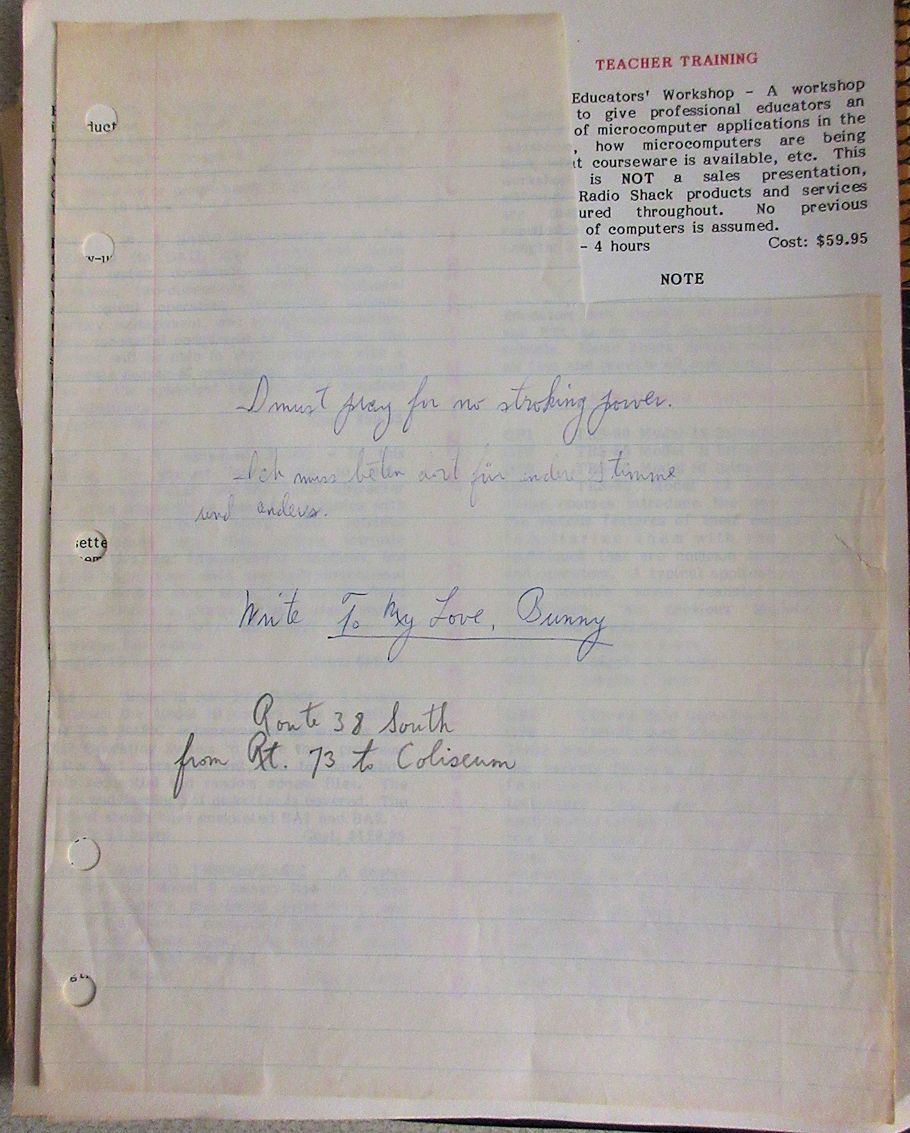
So, in any case, I googled "the artist is a being apart, searching ever after perfection" to find out whether the quotation was my brother's or someone else's.
AI Overview
This quote is from the preface of "Epic Battles of the Chessboard" (also known as Battles Royal of the Chessboard) by R.N. Coles, first published in 1948.
In the book, Coles uses this phrase to compare chess masters to artists, suggesting that both are isolated individuals obsessively pursuing a flawless, perfect ideal.
The full quote, as it appears in the book's introduction regarding the nature of masters, is:
"The artist is a being apart, searching ever after perfection; the rest of us can admire works of art but we cannot create them. As with art, so with chess..."
Context:
Source: R.N. Coles, Epic Battles of the Chessboard (1948).
Meaning: Coles implies that true masters (whether in art or chess) operate on a different level from ordinary people, driven by a relentless, solitary pursuit of perfection.
Chess Application: Coles argues that, like artists, great chess players create masterpieces that others can appreciate but rarely emulate.
Wow.
Right now, I really wish I knew for certain whether the first page above was written before or after Otto snapped into Otto/George circa 28 July 1976.
2025.03.05
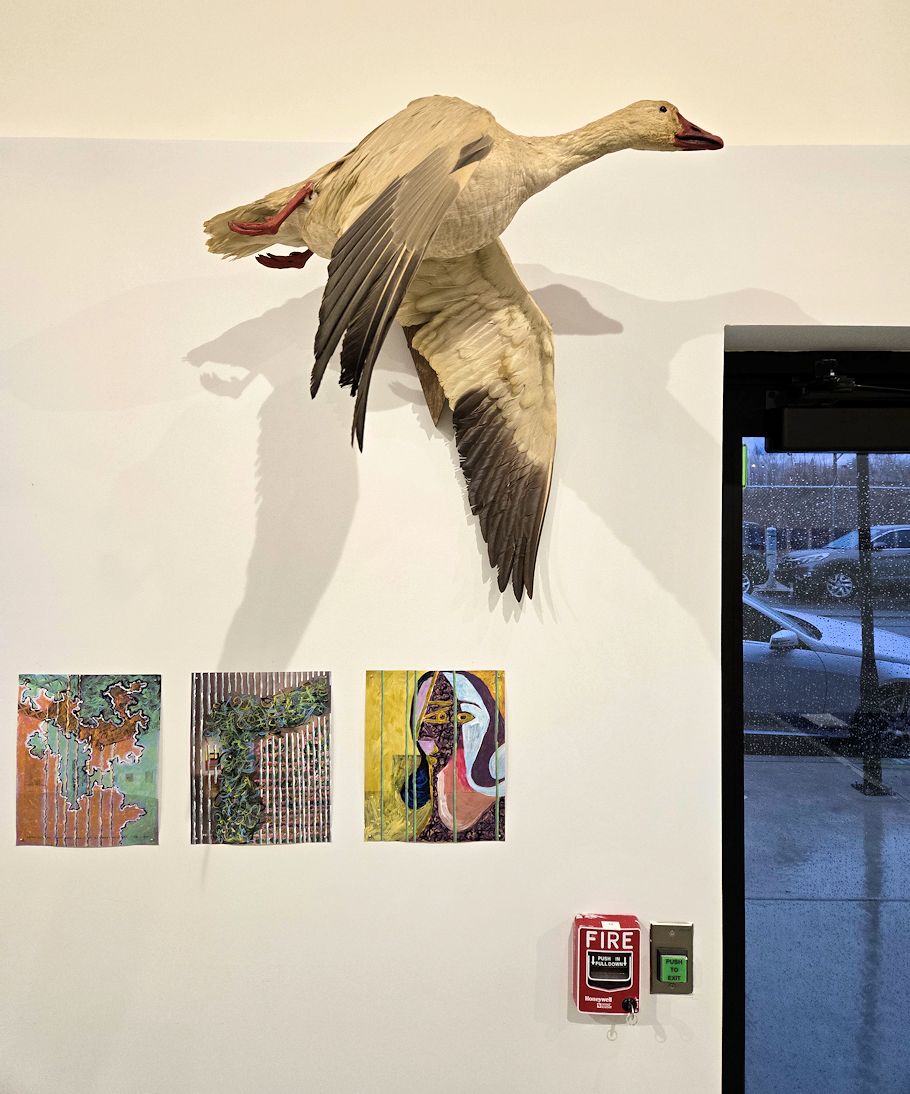
451 Rhawn Gallery
2023.03.05
From The Discovery of Piranesi's Final Project
5 March 2023 Sunday
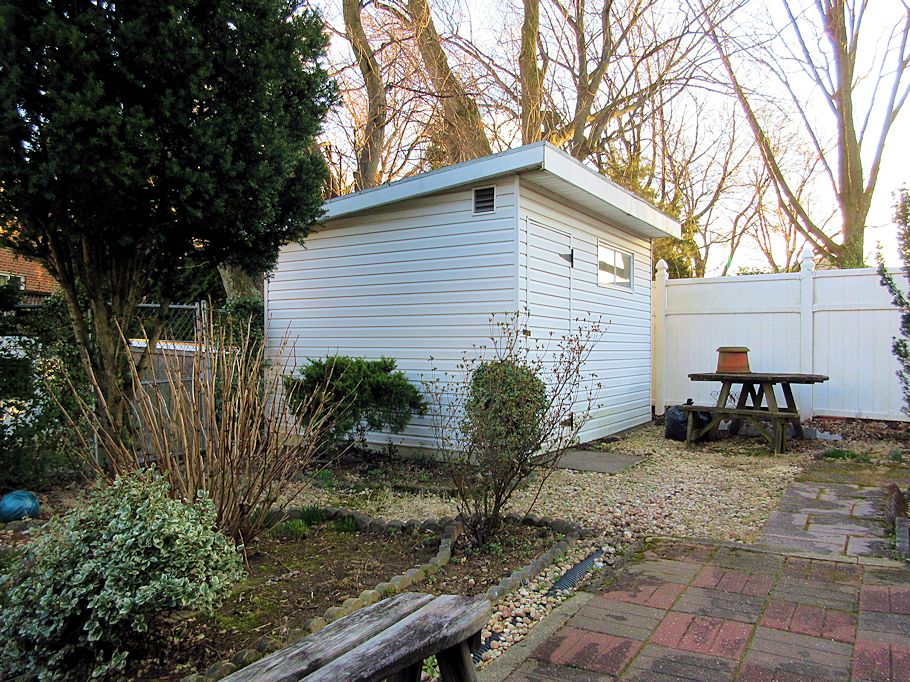
The shed's nickname is henceforth Ury House.
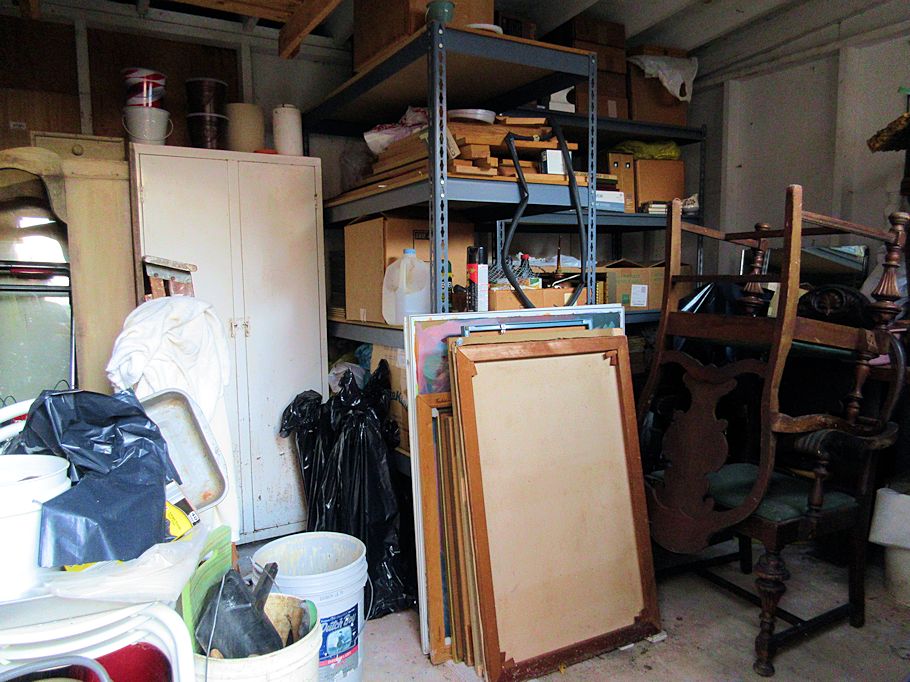
And, if I ever clean it out and turn it into a gallery dining room, then I can invite people to dine at Ury House.
2019.03.05
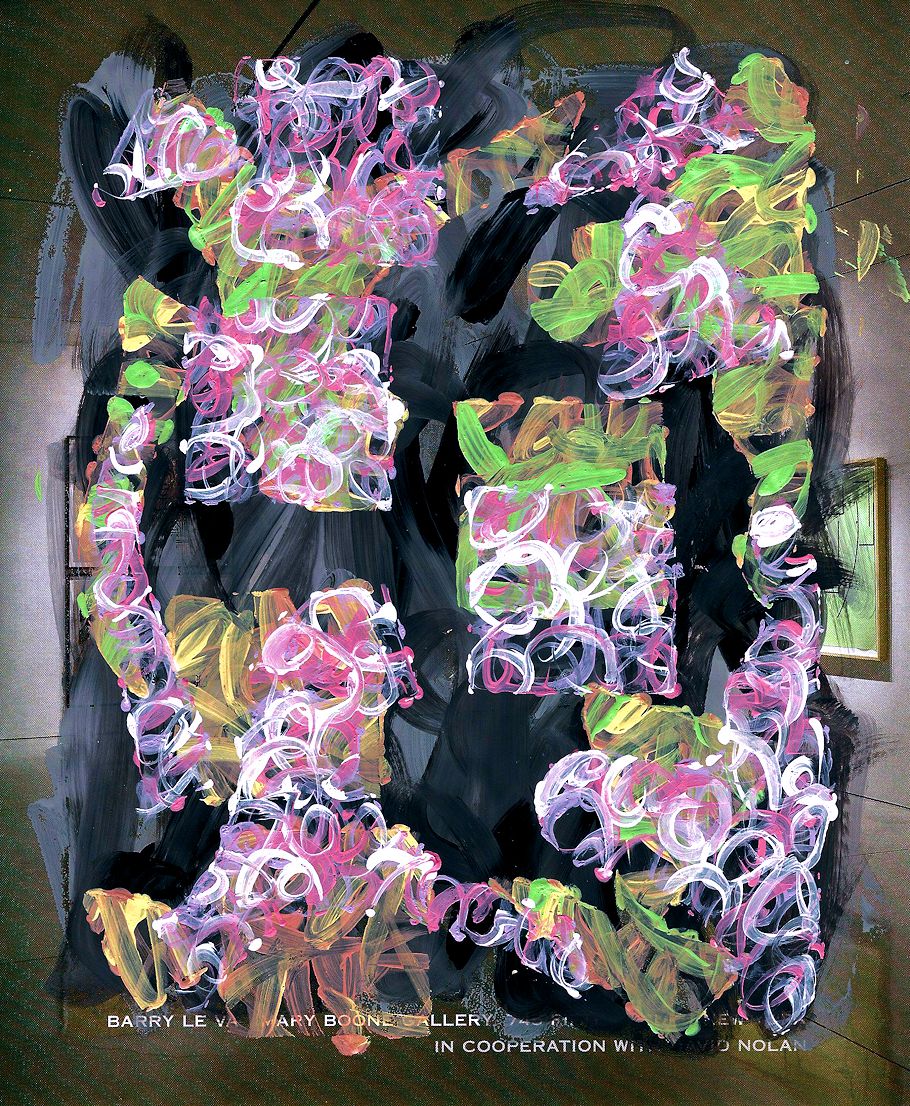
Mary Boone's 180 hours of community service hour 25
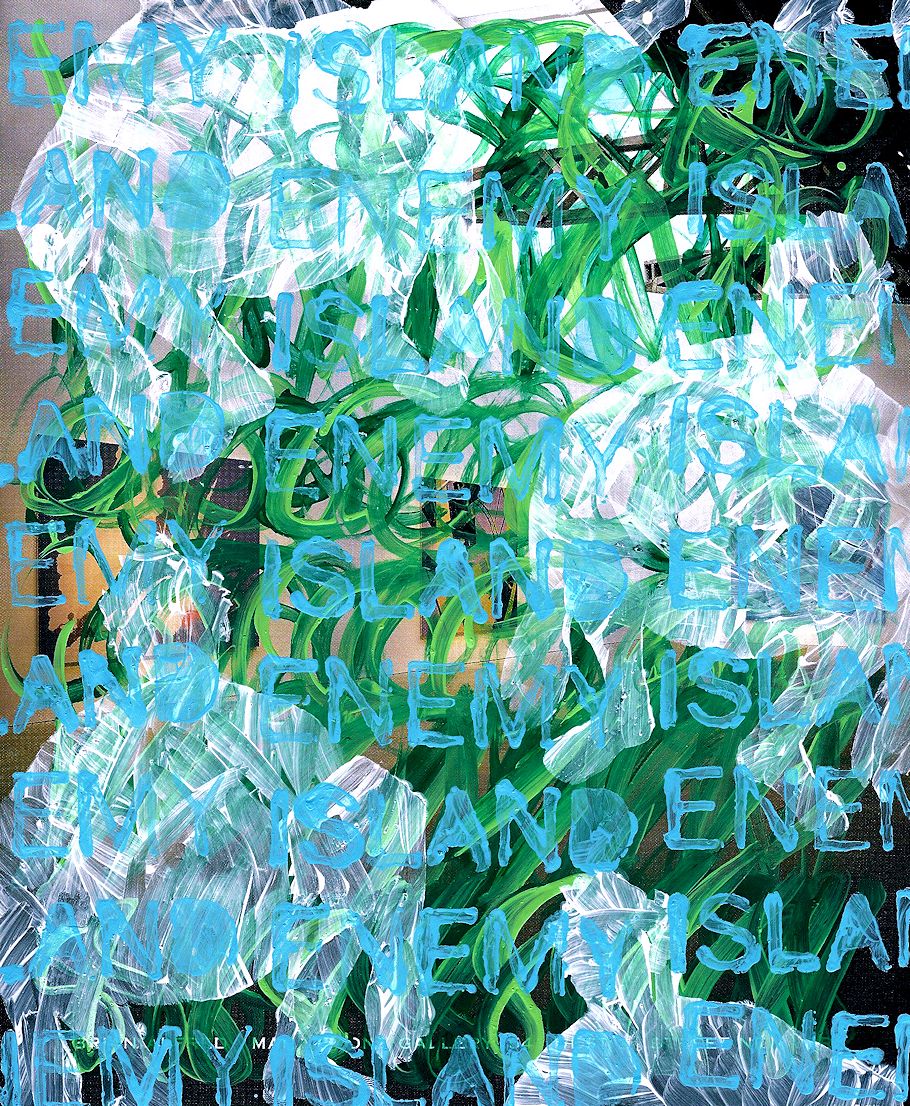
Mary Boone's 180 hours of community service hour 28
2006.03.05
God's will as urban planning?
The selling of indulgences to help build the new Vatican Basilica of St. Peter.
Martin Luther protested; read his 95 theses.
2003.03.05
Re: The Mourning After: A Roundtable
The "re-examination" is clearly a specific re-examination of the "Artforum" 1980s. Thus, this thread at artforum/talkback might be the perfect place to examine (or at least solipsistically display) other (art) aspects of the 1980s. There is not just one time capsule.
Summer 1981: first thoughts about the theory later named chronosomatics occur in a third floor bedroom in a house on 13th Street near Q Street in Washington DC.
September 1982: wearing a Walkman for the first time in LA.
February 1983: Receive CAD training at Intergraph in Huntsville, AL. Visit the "World's First Space Museum." Love the Saturn 5 rocket laying on its side in pieces in the museum's "backyard" next to a farm field.
April 1983: Cooper Pratt Valhonratt Architects are the first architects in Philadelphia to utilize CAD. Bernard Piaia and Stephen Lauf are the CAD operators.
Summer 1983: Jim Williams (of Midnight in the Garden of Good and Evil fame) gives a personal (almost midnight) tour of his entire house (Mercer House, Savannah, GA) to young Philadelphia architect. Said architect sits in the "very same chair that Jackie O. sat in" on the garden terrace. Portion of said tour of the house is uncannily reenacted by Kevin Spacey and John Cusack in the above mentioned mid-1990s movie.
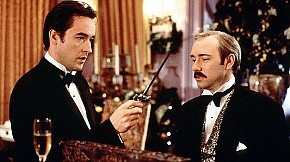
December 21, 1983: completion of Hey Art Picasso How's Your Brother Dick?.
Spring 1984: work on and completion of 2 = Odd, Dick.
Summer 1984: started wearing personally owned (1963, 220S, my car in High School) Mercedes Benz hood ornament before young Black guys are seen doing it. Rumor had it that the hood ornament was really a fake, and that the real one was kept in a vault. AKA the family jewels.
Labor Day Weekend 1985: Art Installation in the "tunnel" at Kurt's Disco, Philadelphia. One wall supported an almost to life-size enlargement of Anonymous Saint In Bikini While Jesus Is Walking On Water. "Sister Bikini" was born among the bartenders.
September 1985: Picked up Jim Williams at Philadelphia International Airport; this is the first stop of his first antique shopping tour after his final release from jail. Checked out the other Napoleon Coronation Coach medallion at the Philadelphia Athenaeum--Williams wanted to make sure the Philadelphia medallion was identical to the one he owned. During dinner, Williams was told about the quartz pyramid within Merrill's The Changing Light at Sandover. "Miss Mysterious Pyramid" was born.
Re: The Mourning After: A Roundtable
[1984] Pumpkin Art
The public opening of the Jonathan Borofsky exhibit at the Philadelphia Museum of Art was 6 October 1984. A picture of Borofsky with numbers all over his face was on the cover of The Philadelphia Inquirer Sunday Magazine the same day. Thus informed I went to the exhibition that afternoon and found it magnificent, and that was before I became a part of it.
After a number of 'standard' galleries displaying Borofsky's works, the exhibition culminated in a very large, double height room within which Borofsky manifest an installation. There were selected works all over the place, photocopies calling for nuclear disarmament all over the floor, and even a ping-pong table with a sign inviting museum visitors to play.
An old woman was sitting on the only chair in the room, a metal folding chair next to a folding work table that looked as though Borofsky had simply left them there after he was finished. I waited for the woman to get up so I could sit there and observe all the reactions of 'shock' exhibited by all the other exhibition visitors.
After sitting there for a few minutes, another older woman came up to me and asked, "You're the artist, aren't you?" I told her I wasn't, but she wasn't convinced. "Well, you're dressed the same as that figure of the artist up there hanging from the ceiling." It is true that both I and the figure of Borofsky "flying" over the room were wearing blue jeans and a red sweater. I was also wearing my beloved John Deere cap, however. Suddenly, I got an idea.
On the table next to me was a pumpkin and a roll of masking tape. I started tearing off pieces of the tape and started giving the pumpkin eyes, a nose, and a mouth. Then I gave the pumpkin crazy hair standing on end with longer pieces of tape. A crowd started to gather around. "Are you part of the exhibit?" "I am now." Other questions were also entertained. Then a big bouncer of a museum guard came up and asked, "Were you told to do that?!?" I crossed my eyes and answered, "He made me do it." Then the guard's look changed from perplexed to angry, so I stood up and whispered to the guard that I did not intent to cause any trouble, and I will gladly leave the exhibit if he escorts me out. The guard obliged and told me I could stay in the rest of the museum, but "Please don't touch anything."
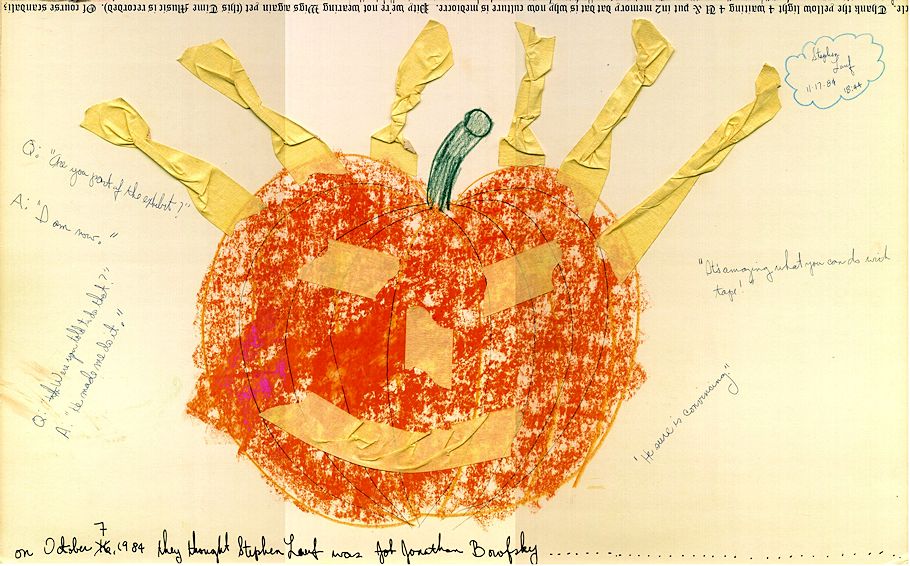
When I returned to the Borofsky exhibit toward the end of its run the pumpkin and the roll of tape were no longer there.
Re: The Mourning After: A Roundtable
from Catalina with love
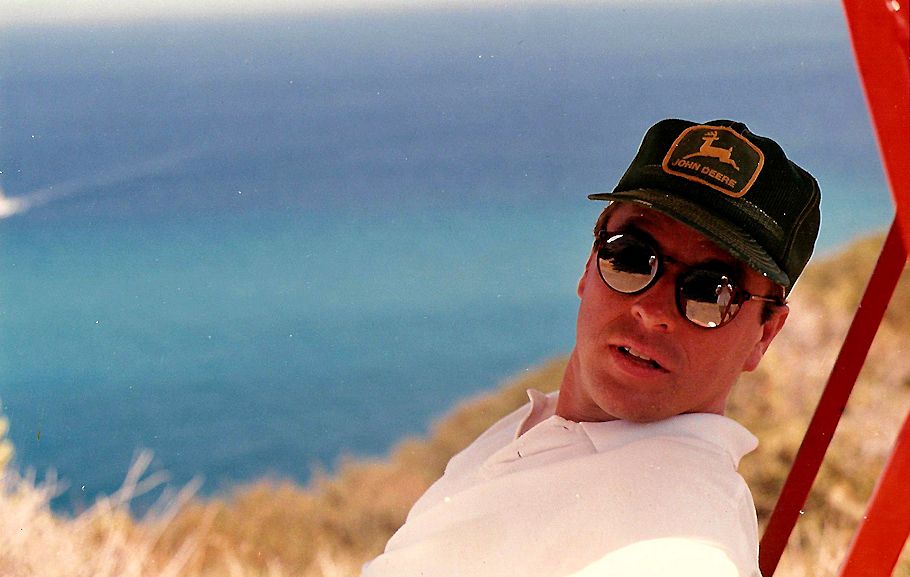
August 1986: touring Catalina Island in a golf cart looking for buffalos after a couple margaritas.
1967.03.05
1967. Sunday, New York City
...
Lebel hopes with Claude Givaudan to engineer an exhibition of the readymades and has also promised Monique Fong that he will try to find a publisher for the essay on Marcel by Octavio Paz [19.1.1967]. Marcel thinks this will be quite difficult, "because the text is too long for an article in a magazine and really short for a booklet (except in 3 languages)."
Ephemerides
|