2026.02.03
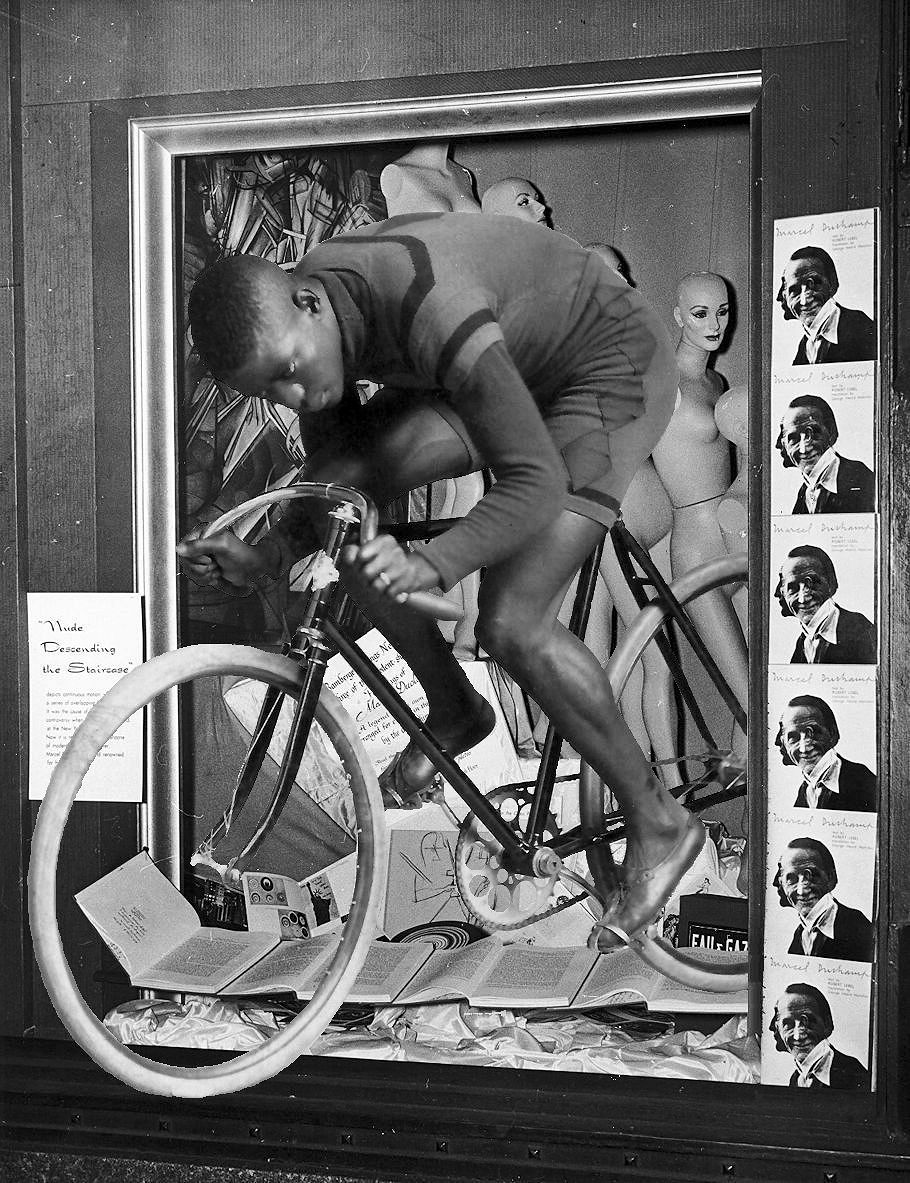
Change of Venue 014 Of modern fame, there's the apprentice, and then there's the master.
2023.02.03
From The Discovery of Piranesi's Final Project
3 February 2023 Friday
It's unexpected, and even uncanny, to now think that the discovery of Piranesi's final project commenced right when Francesco left off, albeit 204 years later in Philadelphia, not Paris, not Rome.
2015.02.03
Blah
Reading Ghirardo's and Sartarelli's 1980 translation of Tafuri's "The Historical 'Project'" alongside d'Acierno's and Connolly's 1987 translation of Tafuri's "The Historical 'Project'" is a very strange experience. A lacuna appears and your mind starts comprehending a whole new and bizarre 'translation' of its own invention. I want to write that translation down.
2014.02.03
This Your Father's License
"In the future, all education will be an advertisement."
"In the future, every generation will be defined by product placement."
2004.02.03
novel ideas
12. There was the idea that Jim Williams, this year at the König Ludwig Lauf, had memorized Gravity's Rainbow, and this is a way to introduce passages which Jim slightly alters to make it all non copyright infringement.
=====
Looks like I'm going to borrow the book again, and maybe I'll actually read it all this time.
Well, yesterday was Constantine's and Elizabeth Taylor's birthday.
March 3rd is James Merrill's birthday. I like how a passage from The Changing Light at Sandover was quoted in Artforum last year.
"My Rita Novel Idea"
6. There are 150 paintings by Rubens at the Alte Pinakothek at München.
13. Eva decided the ball is themed "Korean American Religious Tax Evasion".
15. the reenactment of the Widener collection at Lynnewood.
16. Dr. King comes to Philadelphia and the Liberty Bell every Freedom Day, 1 February, since he was the first in the tradition of having someone famous ring the Liberty Bell that day.
2003.02.03
ideas
Duchamp in Philadelphia
2000.02.03
an answer to "Now what?"
Hugh states and asks:
Such being the case, we can conclude that Decon has run out of steam as a manifesto-led movement, and we must look to its successor. Ideas, anyone?
Steve replies:
Is Decon the only thing to have run out of steam? Has the now pervasive and generally accepted way of looking at and being critical of architecture also run out of steam? For example, does moving from seeing Decon as reactionary to now (maybe) seeing the New Austerity as the latest reaction really convey a sense of meaning beyond the oscillations of fashion and trend? Has each new "critical" building become nothing more than the latest "creation" of the now global fashion show? Likewise, has the element of shock become ingrained within the (elite) architectural profession, the same way shock has become "stock-in-trade" in a good deal of high fashion? [I'm not saying there is anything wrong with the architecture that receives attention and the industry surrounding it being akin to the fashion industry, but I do think there is something wrong about not recognizing the phenomenon as such.]
Here's how I now look critically at architecture (and urban design) both currently and historically:
What architecture is extreme?
What architecture is fertile?
What architecture is pregnant?
What architecture is assimilating?
What architecture is metabolic?
What architecture is osmotic?
What architecture is electromagnetic?
What architecture manifests the highest frequencies [omni-frequency]?
What I've found so far is that some architectures fall straight into some of the categories above while some architectures are categorical hybrids. Here are some examples:
The Pyramids, Stonehenge, St. Peter's (Vatican), Bilbao(?) -- extreme, extreme architectures.
The Pantheon, Hall of Mirrors, Versailles, entry sequence of Schinkel's Altes Museum, Kimbell Art Gallery -- examples of the best osmotic architecture there is.
Classical Greek and Roman Architecture -- pure architecture of fertility.
The Hindu Temple -- the ultimate transcendence from an architecture of fertility to an architecture of pregnancy, whereas the Gothic Cathedral is an architecture of pregnancy, albeit virginal.
All of 20th century Berlin -- the metabolic (create and destroy and create and destroy and ...)
To understand architecture of assimilation, look at the Renaissance, but also look to early 20th century Purism to understand assimilation in the extreme, i.e., purge.
Today's architectures are by and large assimilating and/or metabolic (contextual and/or 'deconstructivist'?).
You're very lucky if you ever see pure examples of electromagnetic or frequency architectures today because they are almost entirely architectures of the far off future.
There are many more examples to offer, but that's all for now. In general, I see all architectures as reenactionary (as opposed to reactionary).
Architecture reenacts human imagination, and human imagination reenacts the way the human body is and operates. The human body and the design thereof is THE enactment. The human imagination then reenacts corporal morphology and physiology, and architecture then reenacts our reenacting imaginations.
1943.02.03
1943. Wednesday, New York City
At noon, the curtain is raised on the window of Brentano's bookshop on Fifth Avenue, which has been decorated by Duchamp and Kurt Seligmann for Denis de Rougemont's new book: La Part du Diable.
Duchamp's black, open umbrellas, the significance of which he said mysteriously, "All women will understand," are hanging by their handles from the ceiling like the formidable wings of great bats. Masking Brentano's red velvet, Seligmann has painted diabolic emblems dating from the sixteenth century on a white backcloth. Devils of all sizes from fifteen different countries now inhabit the little space, and a black table is alive with handfuls of jumping beans.
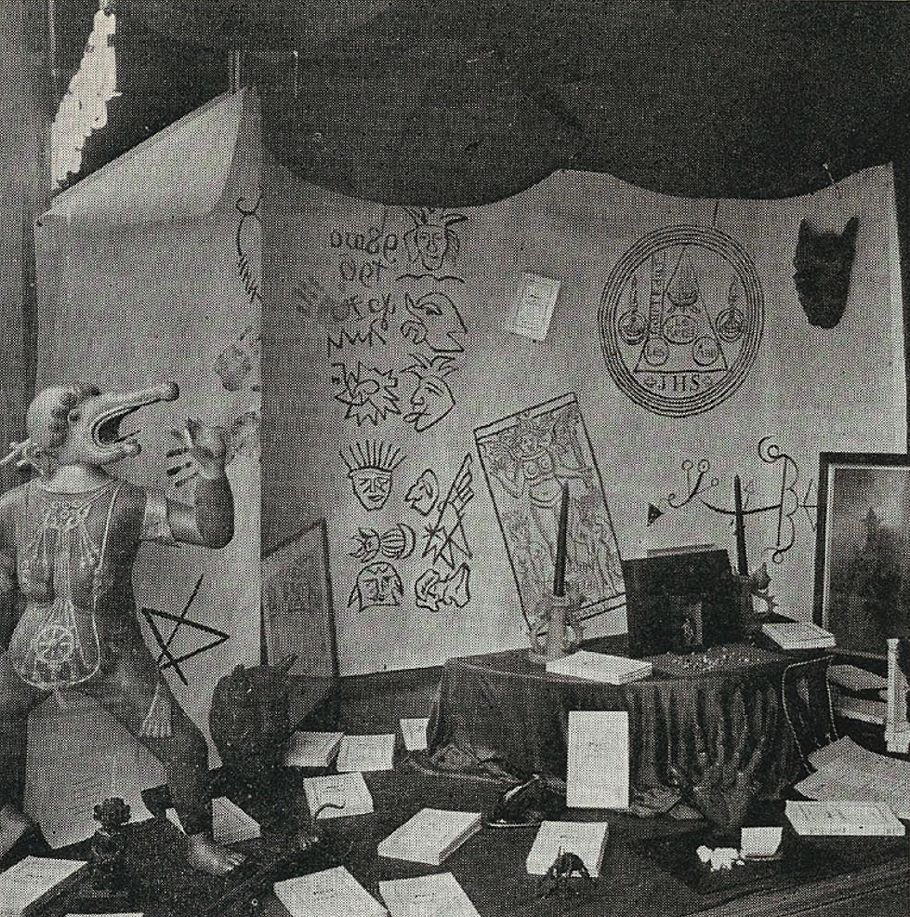
Intrigued to see the reactions of the public, de Rougemont and Breton stand at a discreet distance on the edge of the wide pavement. The first passer-by who stops to look is a negro: he smiles broadly. As soon as he sees the large Tibetan devil standing in the left corner of the window, he starts jumping up and down, gesticulating, making faces, and swearing at the devil at the top of his voice. In a final gesture the man sticks out his tongue and then suddenly slips away, leaving behind him the crowd that has formed.
Ephemerides
|