2026.09.22
a most elaborate introduction of the latest encyclopedic enigma?
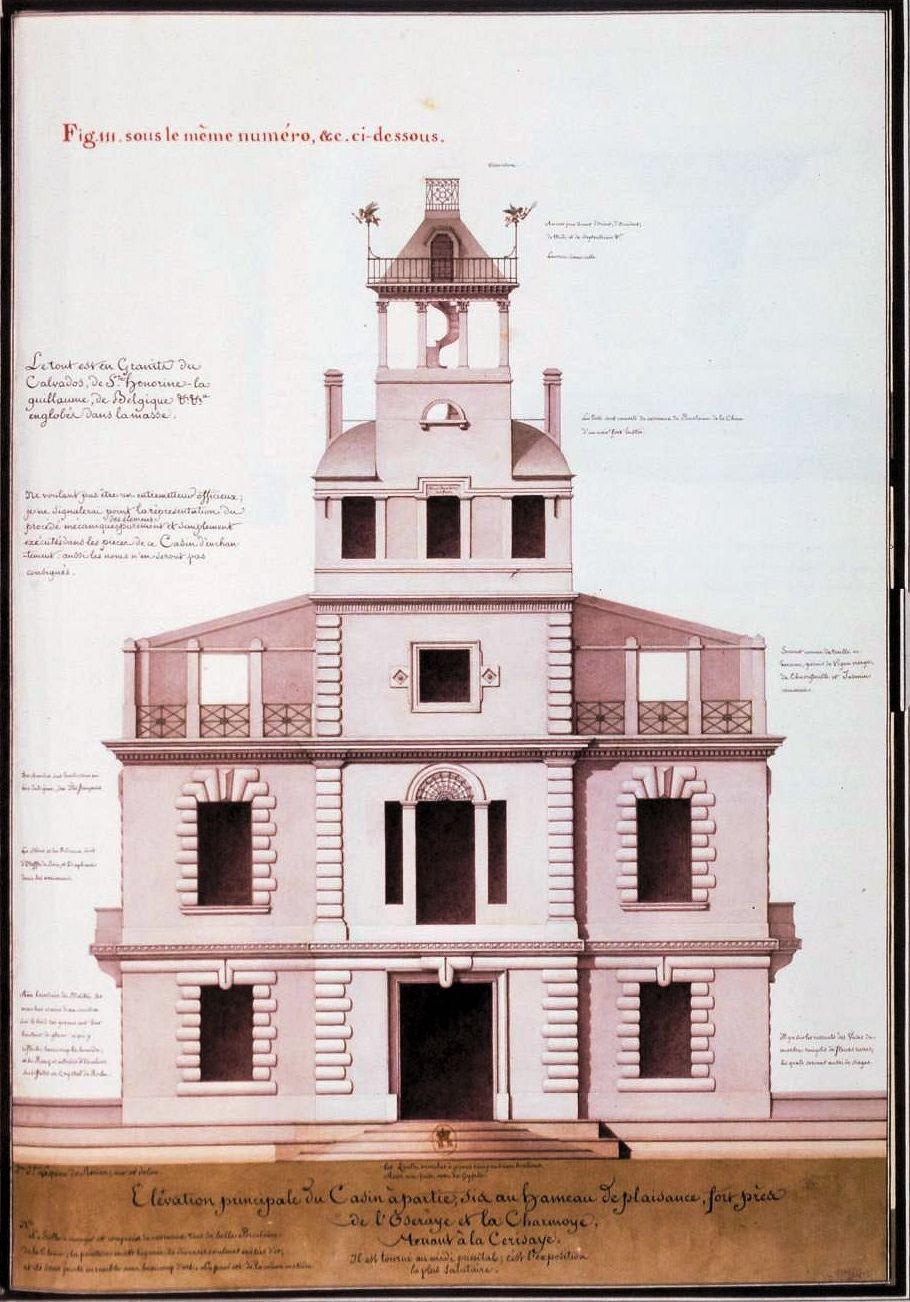
Elevation of the party lodge, situated in the hamlet by the salley-garden and hornbeam copse, beside the cherry-orchard.
This gradually leads us into the realms of 'passionate attraction', with Lequeu's warning that:
Not wishing to be an officious go-between, I shall say nothing further about the drawing of the mechanical device behind the innocent features installed in various rooms of the house of enchantment, nor shall I name them.
This applies to the dildoes which serve as keystones to the doors and windows of the building. Tucked away in another volume we discover the 'mechanical system' of this 'Casin d'enchantement' which reveals the true purpose of the Lodge, which turns out to be a brothel. This mechanical contrivance is a secret lift built into the thickness of the wall, enabling the peeper to make his choice with the aid of a looking-glass:
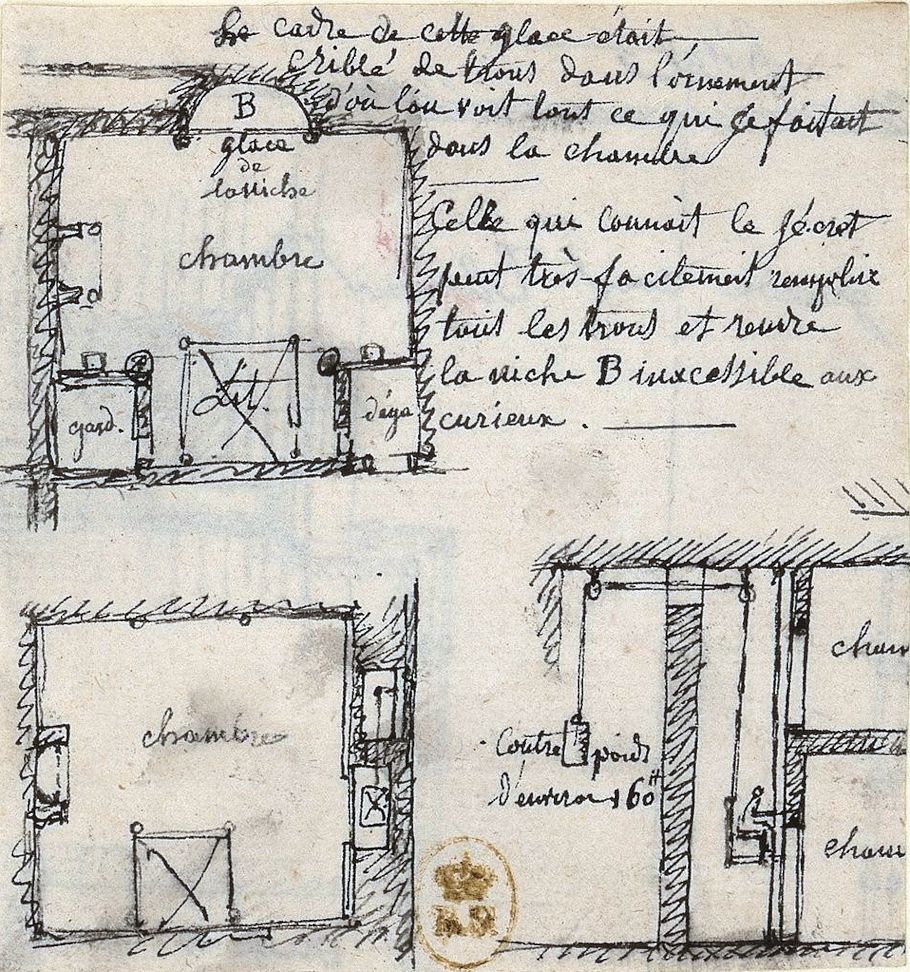
The ornamental frame round the glass was full of holes through which one could see what was going on in the room: but any woman knowing the secret could easily block the holes and make the alcove inaccessible to inquisitive fellows.
These plates introduce sex quite openly. Their tone might be called erotically comic, being -a parody also of Condillac's Traité des sensations and of Le Génie de I' Architecture ou l'analogie de cet art avec nos sensations by Le Camus de Mezieres (1780); but here Lequeu, faithful to Fourier, and especially to Fourier's brother-in-law Brillat-Savarin, introduces 'the genetic sense, or physical love, which attracts the sexes to one another and whose object is the reproduction of the species'.
As a matter of fact, Lequeu, who, as 'Brother of Christ, who has carried his cross all his life', is one and the same as 'Lequeux'--as his name is so frequently spelt in his work. According to the Encyclopédie, his favourite work of reference, the masculine noun queux is an old word meaning cook. Cooking and kitchen thus provide another ground for Le Queu's game. The universe of Fourier and of Brillat-Savarin predominates in such plates as:
Vertical section of the (somewhat artificially adapted) Cavern in the little Park of the delectable Gardens of Isis, completely enclosed, and surrounded by the joyful landscape of the Fortunate Isles.
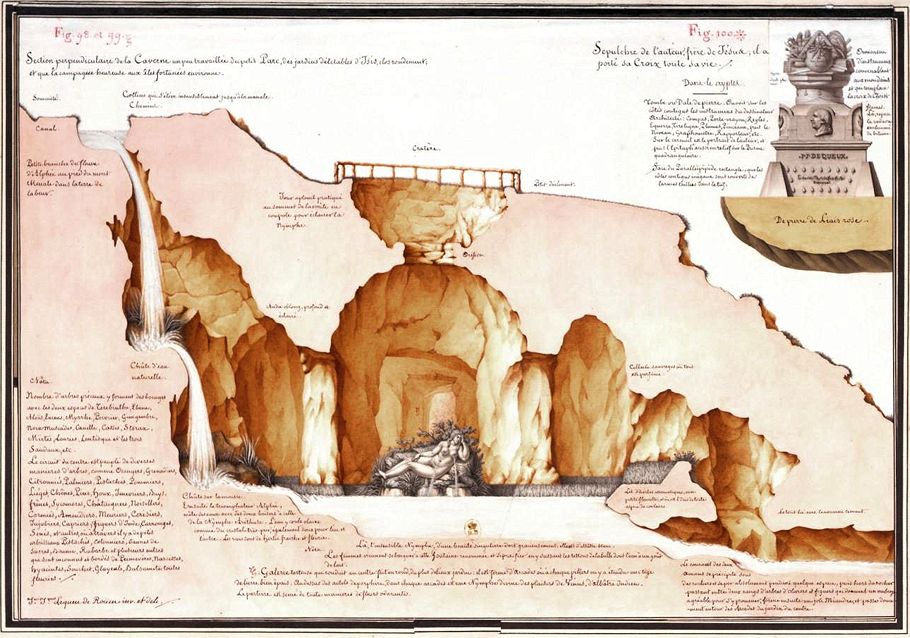
Lequeu's version of this Arcadia shows a strange cavern, an Arethusa's Fountain with its obvious sexual analogy. The pink tint (rose de la coupe) of the cross-section indicates its anatomical meaning. The female sexual organ becomes Lequeu's chosen site for his tomb, on which is written 'J. J. DE QUEUX' (?) with its double play on queux, cook/cock. And the same applied to This site consecrated to God the Sovereign Creator of all living things, stands on the verge of open forest
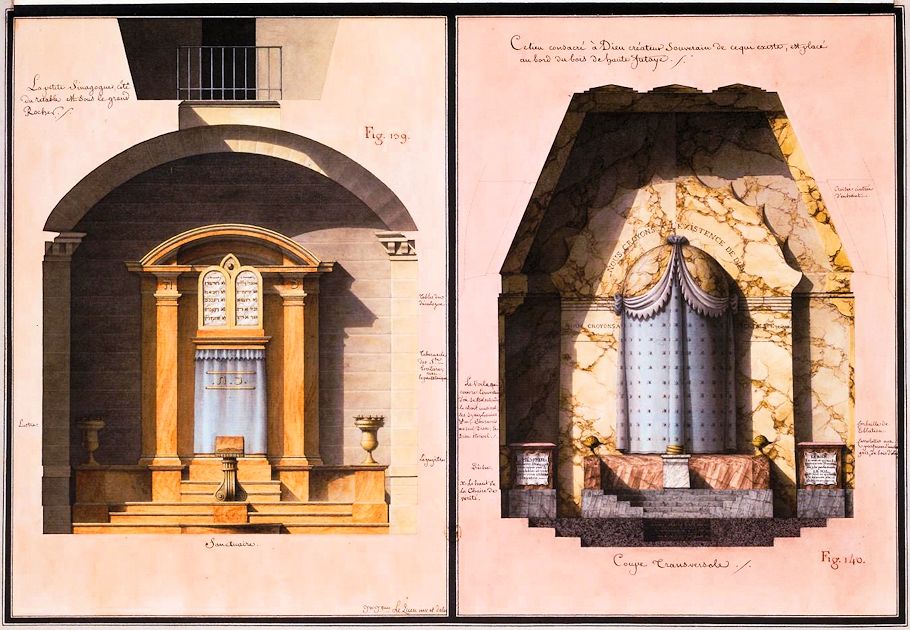
- in which Lequeu has drawn an enormous phallus in the guise of an altar.
However, physical love is only once directly mentioned in the Architecture Civile: This hammock of love lies in the small garden of the most agreeable delights.
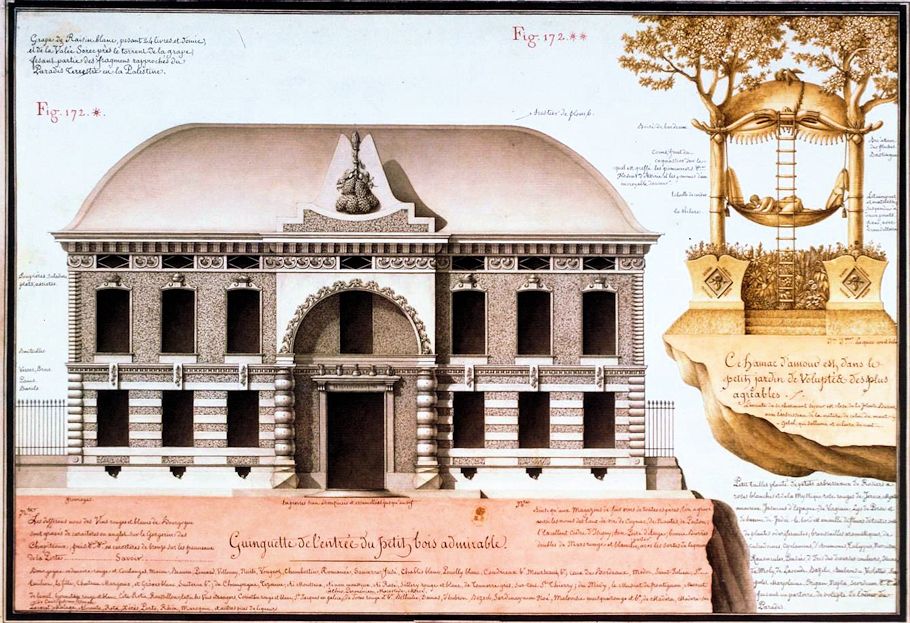
It is near the 'The pleasure-house at the entrance to the lovely little wood'. Here architecture resorts to the 'degree zero' of expression (to use Roland Barthes's term): classical language is thrust aside to give place to 'Soup-basins, salad-bowls, dishes and plates, bottles, glasses, pitchers, loaves, barrels, cheeses', once again emphasizing the dimension of parody in Lequeu's work. The motto 'true happiness is in the countryside' finds its ultimate expression in one of the two drawings that have found their way into the topographical volumes in
the Cabinet des Estampes of the Bibliotheque Nationale:
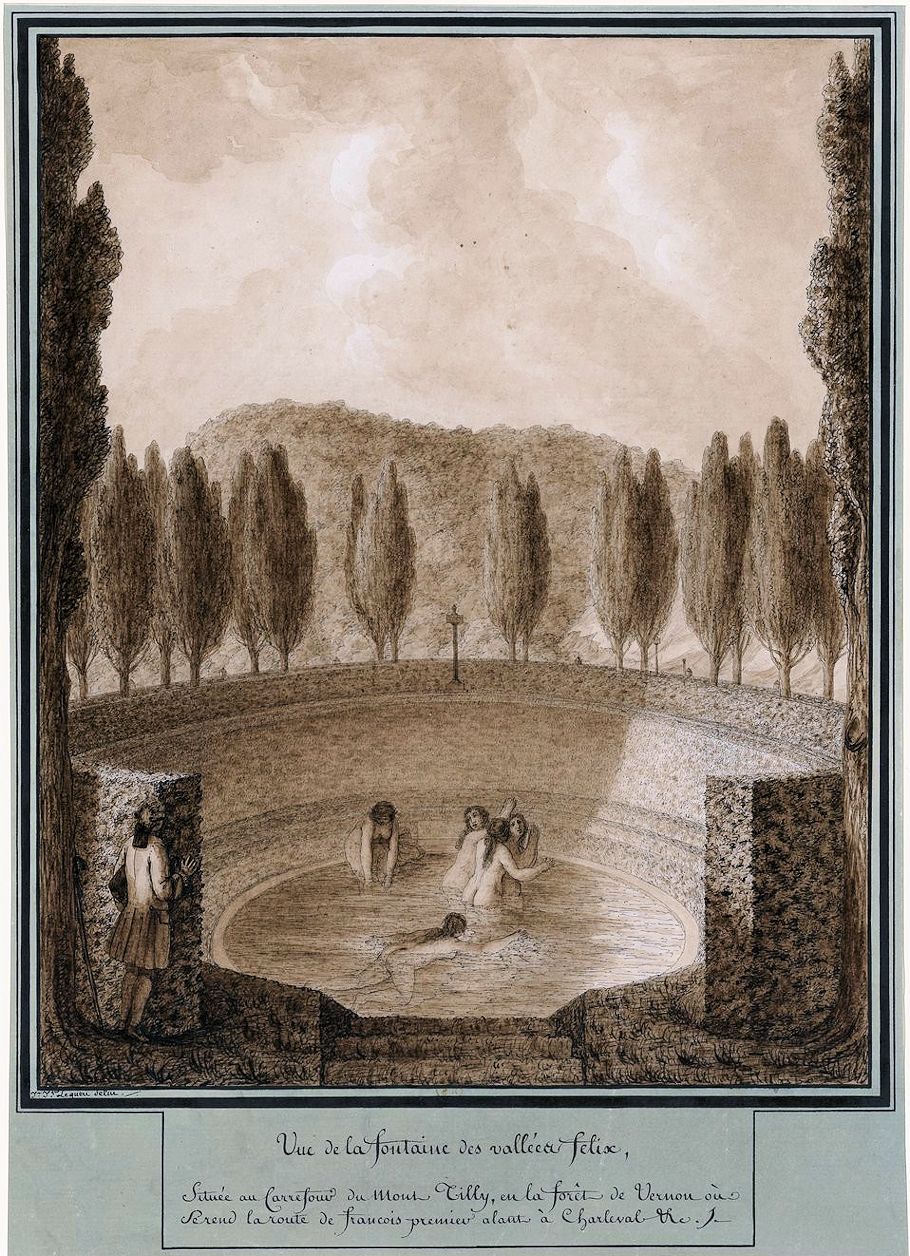
View of the Fountain of Felix [Happy] Valleys, situated at the crossroads of Mont Tilly in the Forest of Vernon, on the highroad taken by Francis I on his way to Charleval etc.
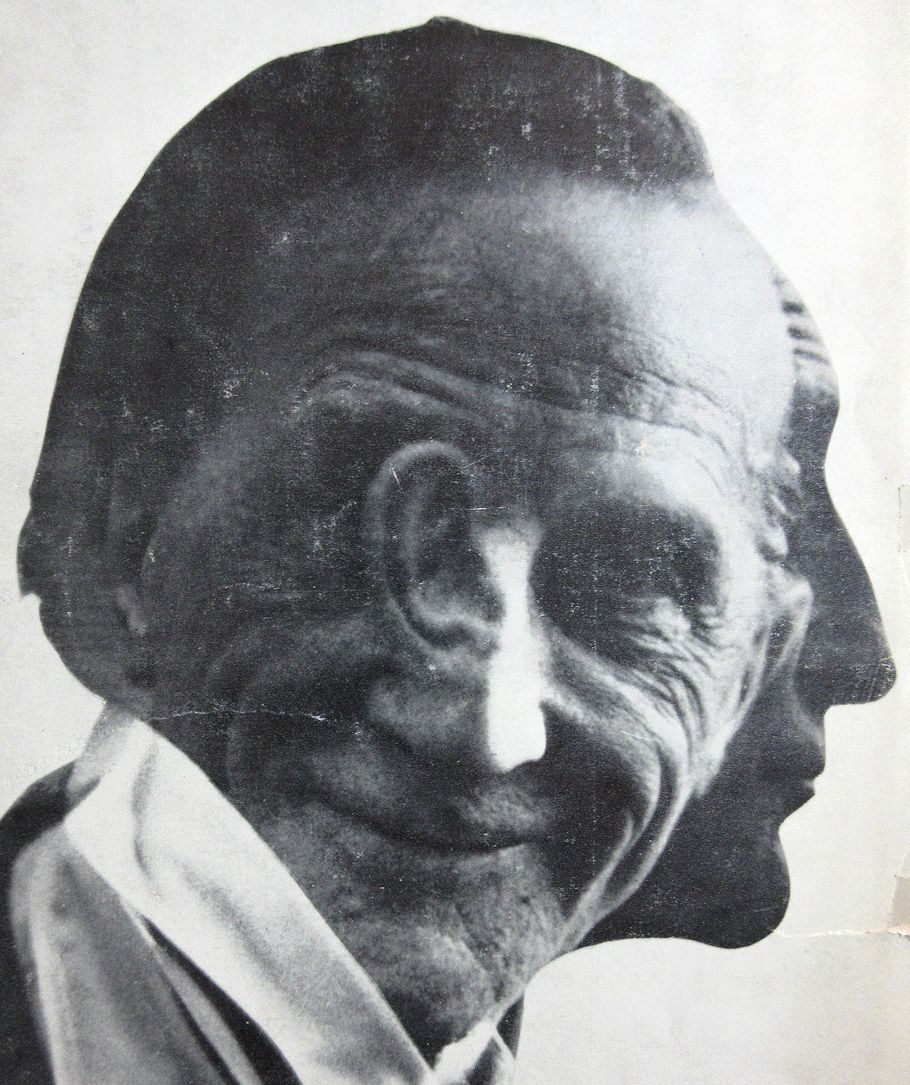
In this Norman version of the Bath of Diana, the myth is transferred to a real place, at Vernonnet in the Eure. But here the mélodrame, in which Actaeon (Lequeu) is shown in the foreground surprising Diana bathing, takes on an unexpected savour when we notice a hidden profile--motes in the sunlight, poussière de soleil--which has become famous in another place and in other times, and which is none other than that of Marcel Duchamp (1887-1968). Thanks to this, Lequeu's work acquires an added significance: that of plagiarism.
In 'La Fontaine des vallees Félix', félix doubles with fait l'x, and the 'x' that marks the spot is none other than Duchamp, the American citizen, the typical Encyclopaedist as defined by Diderot:
The man I would choose for an author would be firm, well educated and well informed, honest and truthful, without country or sect or class, who would tell about the times he lives in as though he were a thousand years away, and about the place he lives in as if he were two thousand leagues away.
If there's a hidden profile of Duchamp in the sunbeam dust, I certainly haven't found it.
2025.09.22
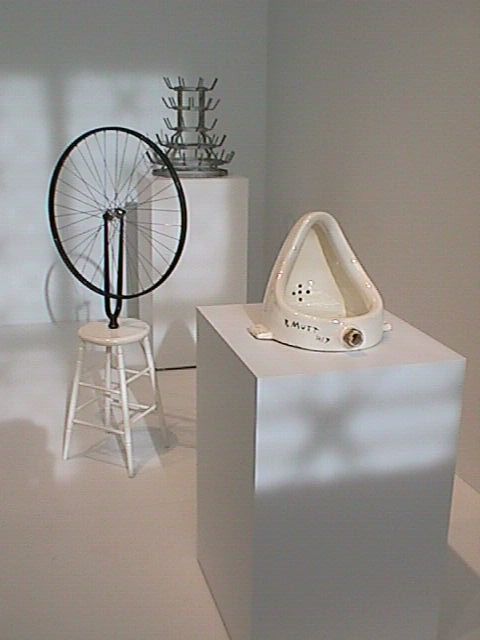
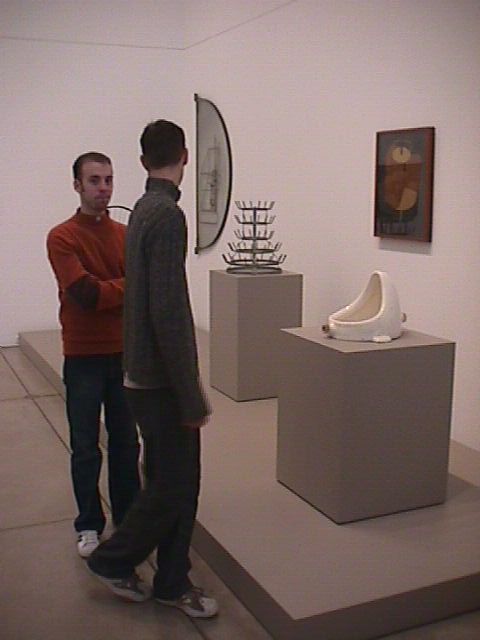
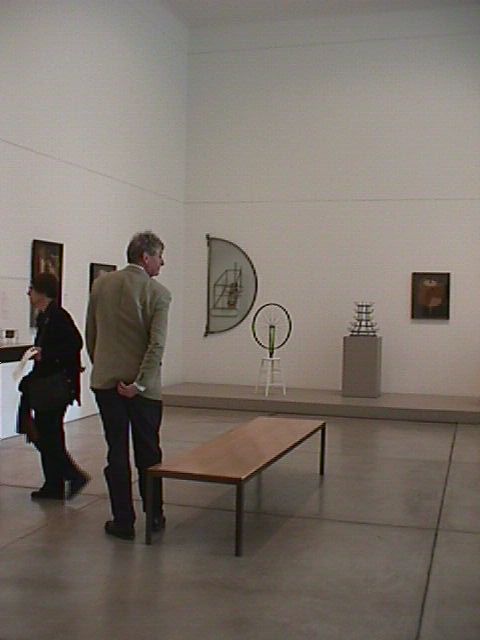
451 Rhawn Gallery
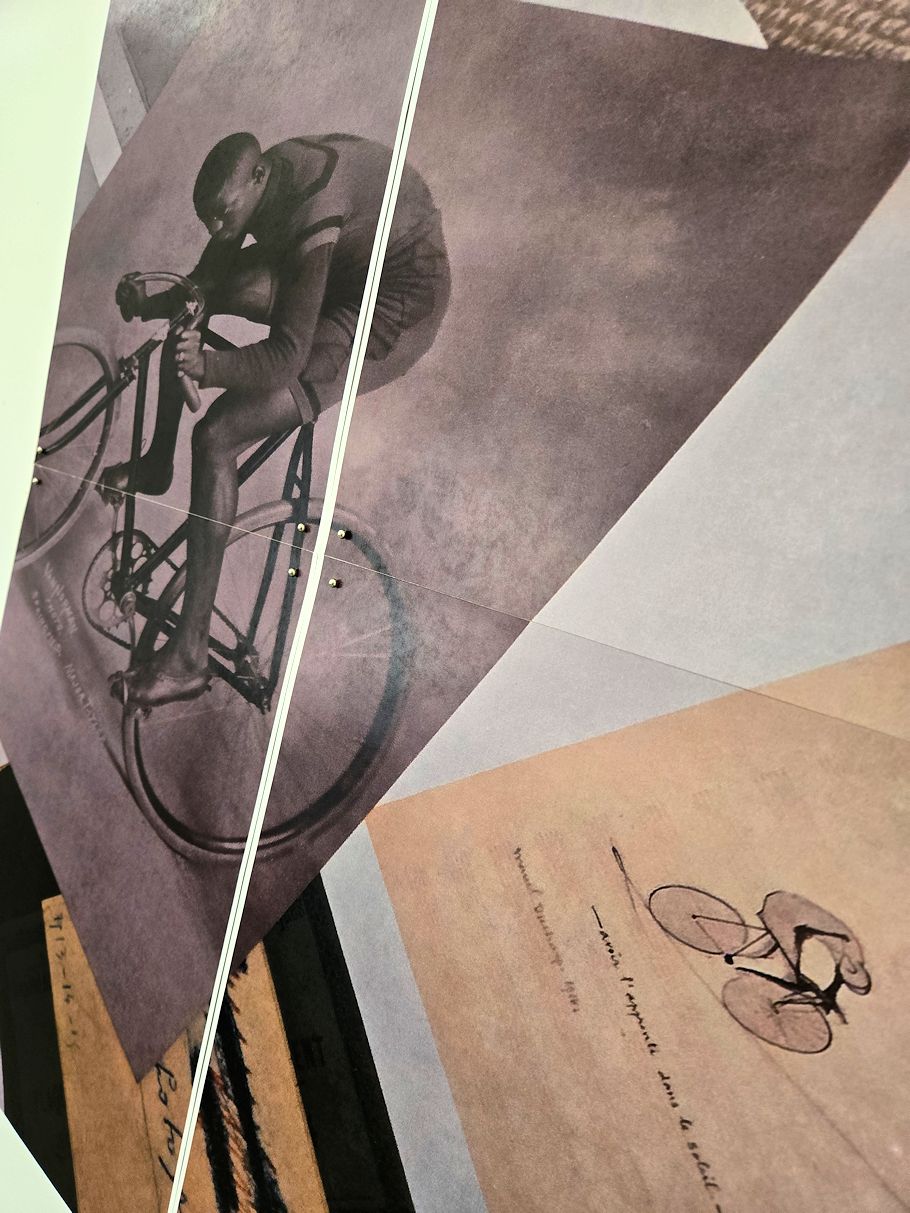
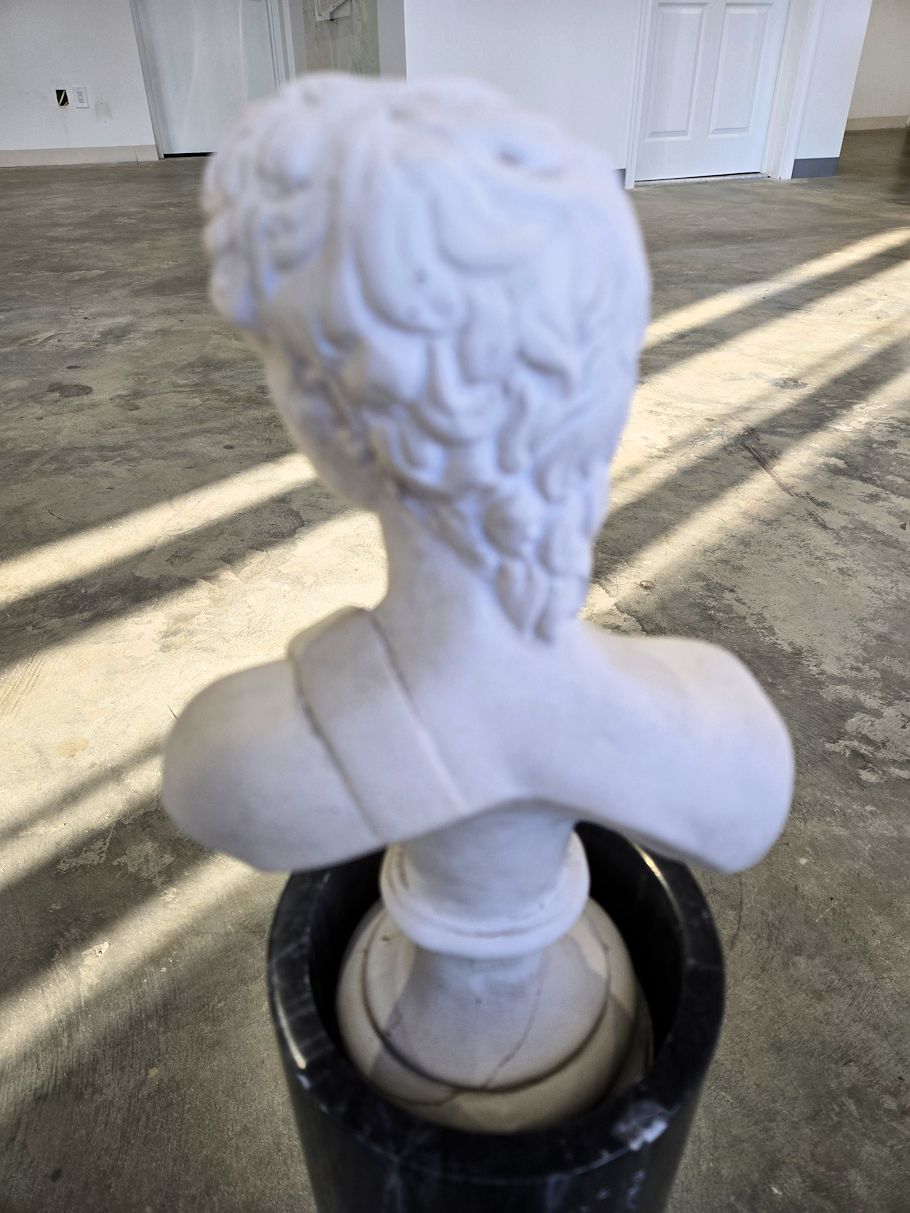
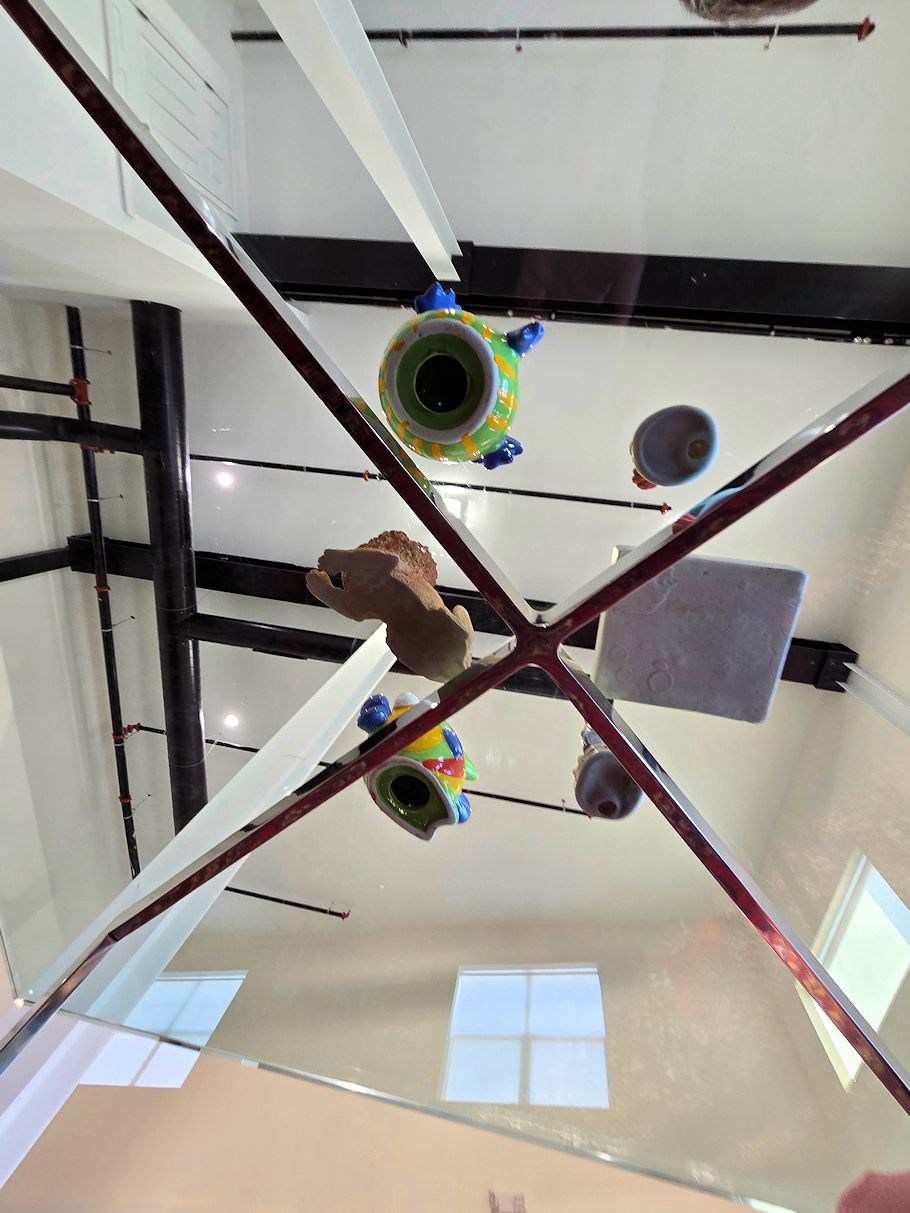
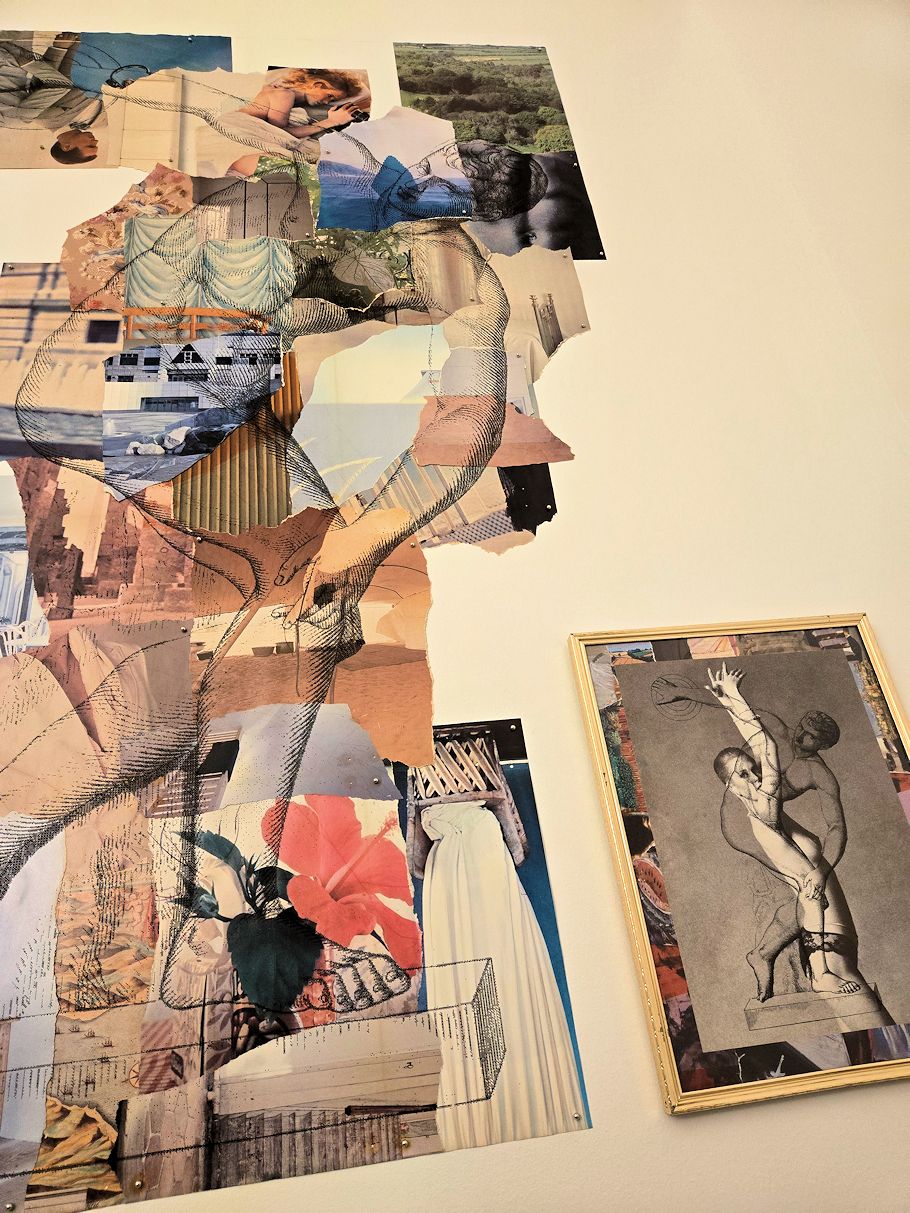
2015.09.22
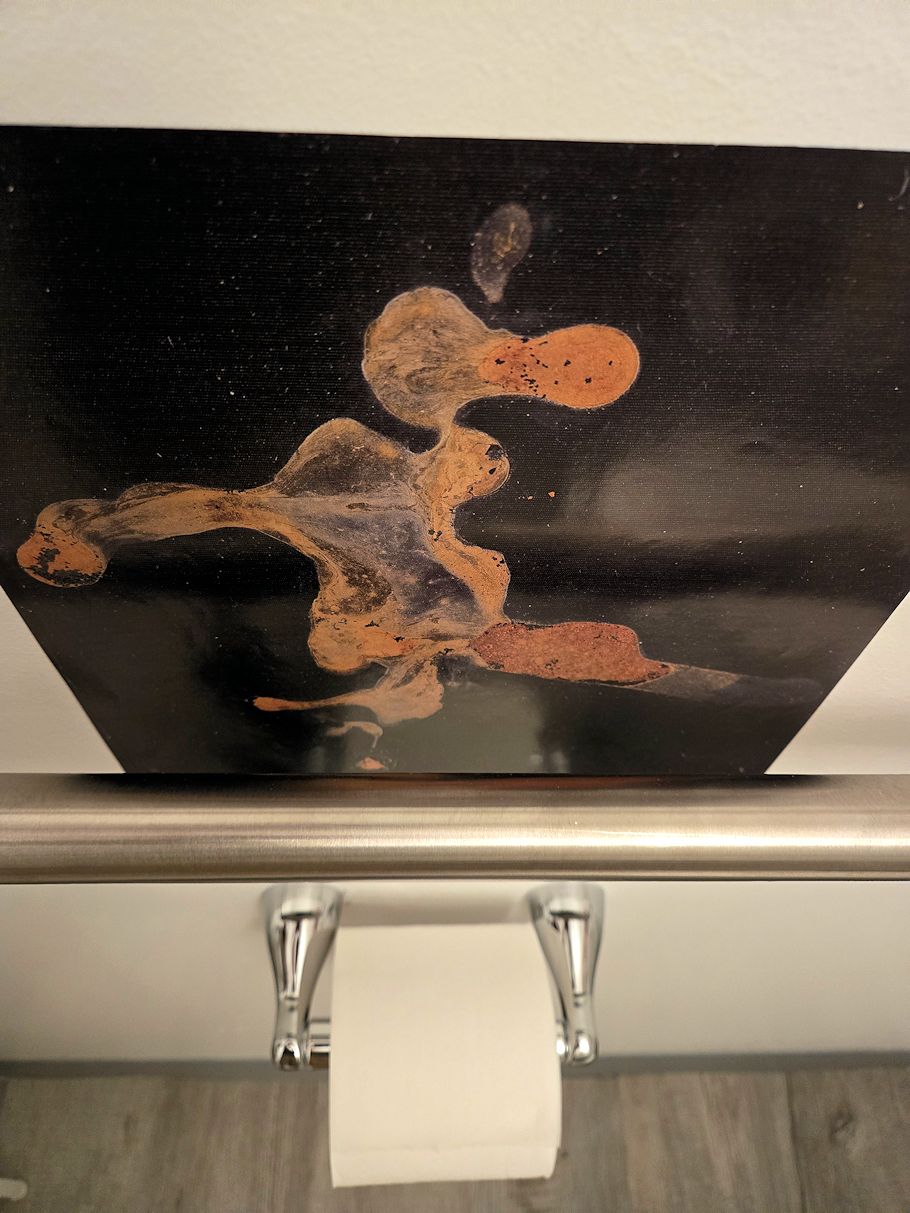
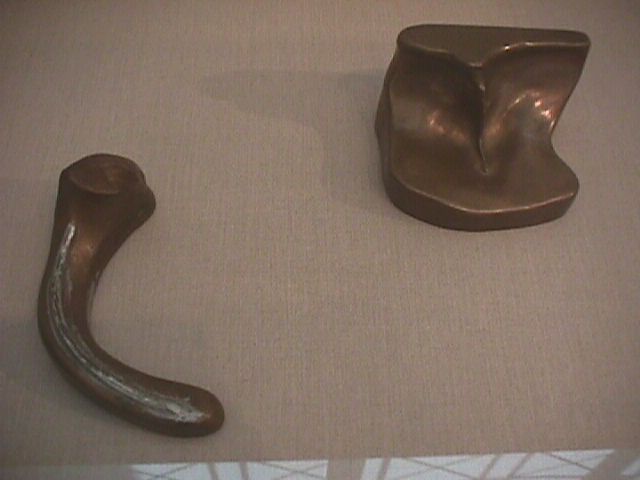
For those with discriminating taste, a competition for the best public restroom in the U.S.
2007.09.22
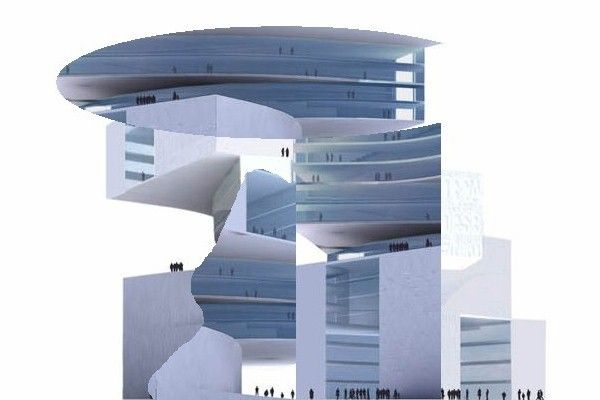
Old School of New Thinking scheme 1
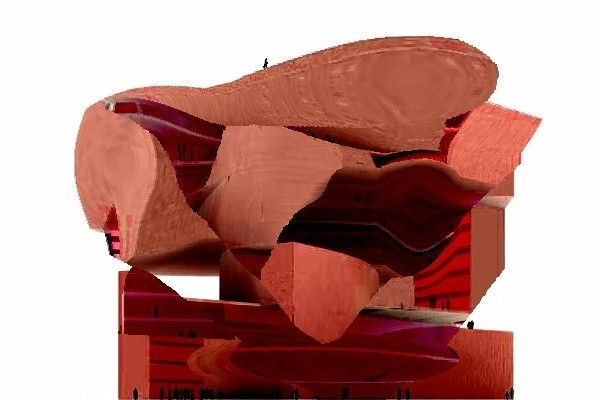
Old School of New Thinking scheme 2
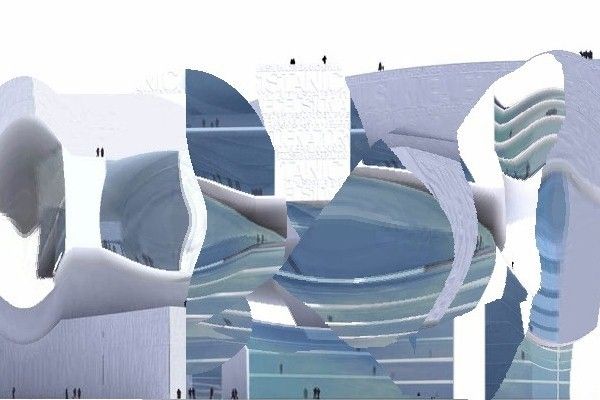
Old School of New Thinking scheme 3
2004.09.22
piss elegant
As soon as the paint was dry to the touch, Jackson broke down the stretcher, rolled the canvas, and transported both to Peggy's apartment building on East Sixty-first Street. When he reassembled it in the low, ground-floor elevator lobby, however, he discovered it was too long-by almost a foot. Sleepless, distraught, and close to panic, he telephoned Peggy at the gallery. "He became quite hysterical," Peggy recalled. That was before he began to drink. Knowing that Jackson would be in her apartment that day, and "knowing his great weakness," Peggy had hidden her liquor before leaving for the gallery. But Jackson soon found it. His calls became more and more frantic. He pleaded with her to "come home at once and help place the painting." Finally, she called Marcel Duchamp and David Hare and persuaded them to rescue Jackson. "Peggy wanted us to tack it up," Hare recalled, "but it missed by eight inches so we cut eight inches off from one end. Duchamp said that in this type of painting it wasn't needed. We told Jackson, who didn't care." By then, Jackson was too drunk to care. Weaving and incoherent, he walked into the apartment where Connolly's party was already under way, crossed the room, unzipped his pants, and peed in the marble fireplace.
The demons were loose again
Steven Naifeh and Gregory White Smith, Jackson Pollack: An American Saga (New York: Harper Perennial, 1991) pp. 468-9.
Between studies there were a good few parties at Yale: parties in the Rogerses' house when their old lady was away in Florida; parties in Eldred's attic, parties given by other students, and above all a big party given by Paul Rudolph for Jim, which has become legendary. Richard Rogers vividly remembers the crucial episode at it: 'He had this amazing modern, real extreme modern, slightly Hollywood apartment, with steps coming in at the higher level, marble steps cantilevered off the wall. At the end there was a double-height wall of glass, and outside this there was probably seven foot of open space before a big white wall. The wall had a great light on it so you looked at it as though it was the screen of a cinema, and the light reflected back into the room -- absolutely white. And everybody else was there. There was a piano, and let's say a hundred people. An hour later, still no Jim. No Eldred. Door opens up at high level, there's a commotion, yells and giggles and so on, and then suddenly there come Eldred and Jim, down these cantilevered slightly marbly steps, giggling because they're canned, literally just rolling down these goddamn steps, drunk. It was a great entry. Paralytic. And like a lot of these paralytic situations, they didn't hurt themselves. A few minutes later Jim says "Where's the loo?" Somebody says, "Oh, it's upstairs." Jim says, "Fuck the loo" or something, goes into the space outside, in front of this unbelievable white screen, turns round and pisses against the glass, with about a hundred people who could look nowhere else. Like on a cinema screen.'
This story is endlessly retailed. It is the best known of the many stories about Jim. All the versions are a little different, not surprisingly, as everyone was well stocked up with drink when it occurred. It has been improved on -- it seems likely, for instance, that the people at the other end of the room remained unaware--but it happened. Rudolph hated to talk about it. Other people have different theories about why Jim did it: Rudolph had flayed Jim at a crit, as was sometimes his way with critics as well as students, and this was Jim's way of getting back at him; it was a 'sod you' gesture against the Yale establishment; it was just because Jim was drunk and happy. Perhaps it was a bit of all three, perhaps mostly the last. Explanations vary, but the basic image remains: Jim, with a big grin on his face, peeing against the glass.
Mark Girouard, Big Jim: The Life and Work of James Stirling (London: Chatto & Windus, 1998), pp. 124-5.
In the future, everyone will piss for 15 minutes.
the posthumous Duchamp
2003.09.22
Re: evolution and aesthetics
P. asks: But where is the principle in architecture which is equivalent to that of mathematics? If there had been one - why would we have styles which change throughout history. Where is this constant here? How does it show itself in history?
Steve replies: Earth's gravity is for sure a constant [force] that all architecture has to contend with. For example, although styles change, the predominant notion of floors being level doesn't. How does an arch best resist gravity? Via it being rounded or via it being pointed?
Another constant [force] that architecture always (has to) deal with is climate, and the fact that climate varies significantly dependent on location may well explain why (for most of its history) architecture (style) varies significantly dependent on location. Odd/funny how a great many of the buildings designed and executed today strive to have a constant climate inside regardless of where the building is outside.
"What climate does the inside of your building reenact?"
"I love how your design pointedly reenacts a resistance to gravity."
Perhaps Disney's greatest achievement is the making of lots of money reenacting reenactments.
"What New Urbanism is doing is great. We should reenact that reenactment here."
"This is my greatest design yet! It reenacts both evolution and aesthetics!"
1968.09.22
1968. Sunday, Neuilly-sur-Seine
"It all seems very well planned," replies Marcel to Brookes Hubachek, who is organizing their forthcoming visit to Chicago, "but we know how hard it is to make the final arrangements and we want you to know that we will adjust with pleasure to whatever you decide." He tells Brookes that he has been unwell recently, "so I do not want to exert myself too much although I will prepare a few remarks for the dinner," he promises. "What we want to tell you mainly is that we would prefer to be alone with you and the family on the free night."
With great excitement at his discovery, Duchamp writes to Arturo Schwarz: "Just imagine, I have found the book on the anaglyphs in the same bookshop where I had bought it around 1930, while taking a walk on the Boulevard Saint-Germain following a very vague memory--The Vuibert bookshop is still at the same place and the book is still on sale (4th edition). I will show you my sketches [20.8.1968] for the French de luxe edition when you arrive."
Ephemerides
|