2025.12.18
"But it was the Philadelphia Museum of Art that intrigued Duchamp the most. Because what Duchamp was after was not simply a space to house his works." (Rose, 329)
"And so he commuted between the two cities a few times a week by train, though more and more he stayed here." (Rose, 330)
You know how they say, "You can't make this shit up!"? Well, the above are perfect examples of shit that can only be made-up.
@451.rhawn.gallery . . . the almost complete(ly) assisted readymade TEENY AND MARCEL
(die) Komtesse less
witch might entitle a poetry book
with a small section entitled
"You can always count on a haiku."
yet commences divergently with
I am...
I am Bic!
iambic pentameter
2024.12.18
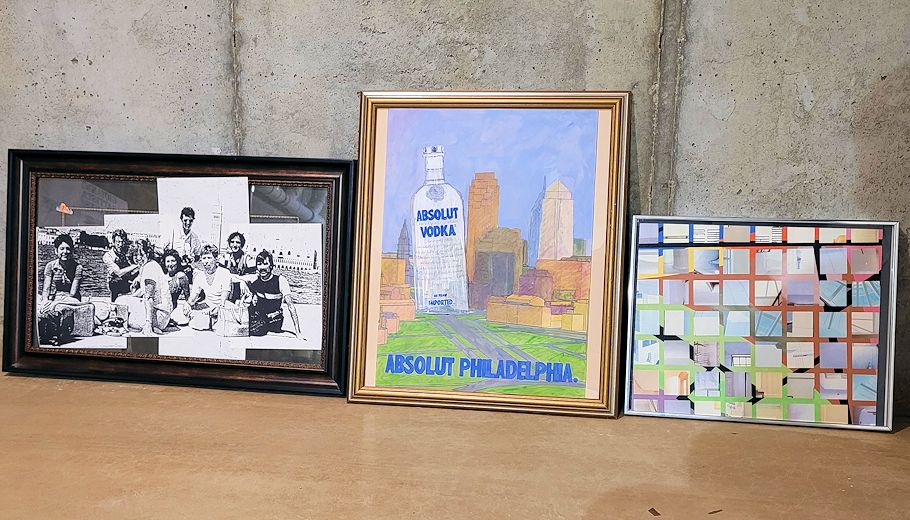
451 Rhawn Gallery
2019.12.18
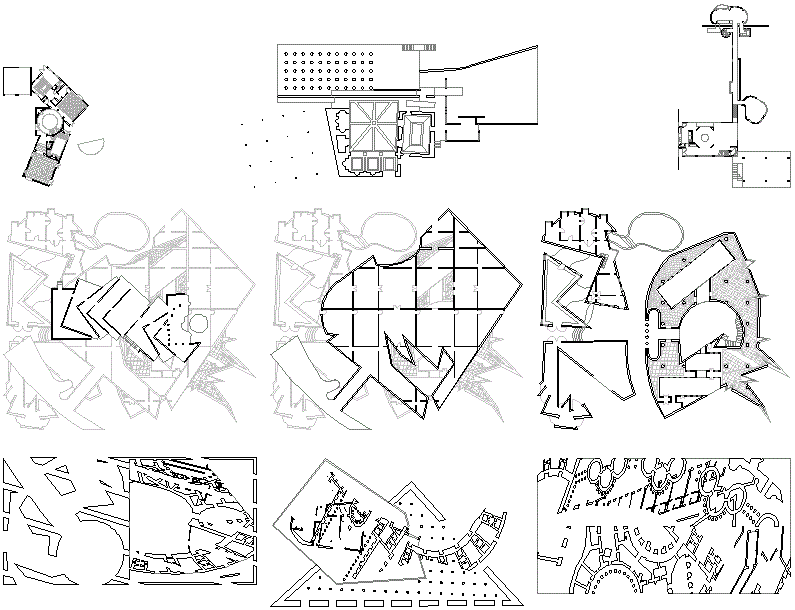
19121801.db atypical house plans Cooper & Pratt House Mayor's House Ur-Ottopia House Green Enfilade House Zany House 001 Zany House 002 House for Otto 5 7 8
2015.12.18
racing thoughts
The building pages of novel, appositions, etc. should/could be a continual development of the building designs via selective modeling and (colorful) presentations thereof. Start some modeling of Green Enfilade House and the Zany Houses and further exploit the existing models of Wacko 001 and Laguna 001 (as if they were like some kind of found ruins). Placing these designs in some kind of (IQ) context should also be part of the presentation/story.
Exploiting Villa Savoye and Wall House 2 into new types of (21st century?) houses. Savoye was like split and a new house was developed between the two parts, and the parts were maybe rotated slightly. That idea came out of the notion of turning Wall House 2 into an Andalusian House with a striped wall and striping the room/forms and further deformations. And then doubling Wall House 2 where the two walls enclose the clashing room/forms on both sides. It's to be colorful and late Hejduk.
2013.12.18
18 December
Reading 'conceptio' (a feminine noun) means (1a) a comprehending; hence concretely, a circuit, compass: the system of the universe [and here Vitruvius is cited as the source of the concrete meaning] again today made me wonder anew as to the significance of the compass of the Ichnographia matching exactly the plan of the Porticus Neronianae.
2002.12.18
Re: some drawings
It turns out that I very likely used a ball-point pen while drawing exactly 19 years ago today. Recent discussion here has gotten me thinking of things somewhat otherwise forgotten. I remembered that Hey Art Picasso How's Your Brother Dick was completed sometime in December 1983, so I got it out of storage to check the dates next to the signatures. Hey Art... comprises a series of 25 19.416x12 inch (golden section) panels, each with its own signature. The last 4 panels, numbers 22-25 in the series, are dated 12.21.83; number 21 (purposefully I now assume) has no date; numbers 19 and 20 are dated 12.20.83; number 18 is dated 12.19.83. Panel number 17 is dated only 83, as are all the preceding panels. Thus tomorrow 19 years ago marks the first time I dated a work (of art) down to the day, an 'event' of significance within my own development as an artist--at that time I was working with CAD for almost 3/4 of a year, and the more precise dating of my work (by hand) emulates the computer's precise dating of its output. Within 2 = Odd, Dick (1984), second of The Dick Manifestos, I started dating work completion down to the minute, and continued this practice at least through 1986 (and occasionally still do it these days down to the minute).
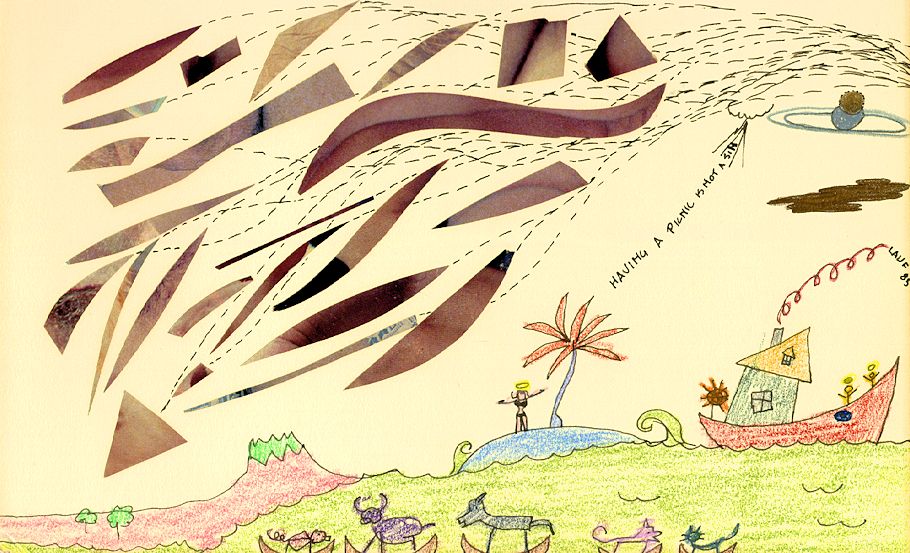
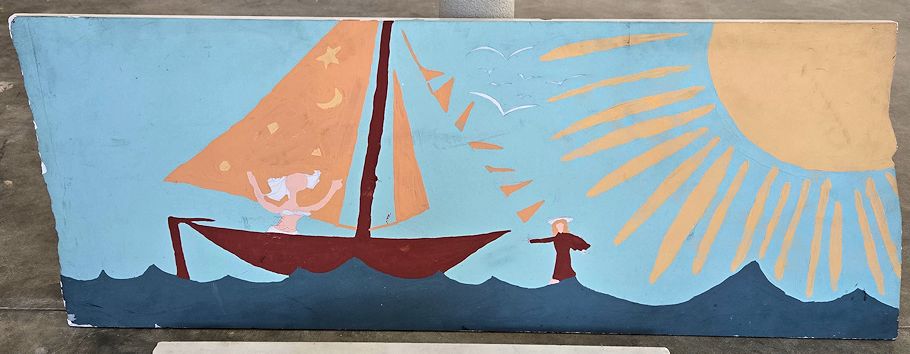
It turns out the ball-point pen drawing I (very likely) did 18 December 1983 is the precursor to the image of Anonymous Saint in Bikini while Jesus is Walking on Water. This data is somewhat useful to Playing the Pre-Shrine Curator because ASIBWJIWOW is not dated or signed. There is recent speculation that ASIBWJIWOW is the first artwork by Stephen Lauf after his completion of the first Self Portrait. I kind of remember wanting to do something completely "other" after the Self Portrait, and painting like a child on a heavy, flat piece of marble seemed to at least fulfill that intention.
2000.12.18
where does concept come from
I realize that the argument can be made that both physical conception and mental conception are equally derived from concipio, therefore it is not necessarily so that the notion of mental conception reenacts physical conception. [Or does it?]
1997.12.18
more daring @ Quondam
...far more manipulative of the model and 2D data in the collection. ...collaged-distorted designs demonstrating the true possibilities of "virtual" space and museums of architecture. ...new definitions of museums are also being created in the process--a "virtual" museum can go beyond the "mission" of a real museum.
1994.12.18
The Sacred and the Profane
From The Sacred and the Profane, p.201:
"From one religion to another, from one gnosis or one wisdom to another, the immemorial theme of the second birth is enriched with new values, which sometimes profoundly change the content of the experience. Nevertheless, a common element, an invariable, remains. It could be defined as follows: access to spiritual life always entails death to the profane condition, followed by a new birth."
This is Eliade's conclusion to the topic of the second birth. Again it ties in perfectly with the Timepiece. My only reservation, thus far, is the negative idea of death, and in this case death to the profane. Is the era of metabolism really so profane, and likewise, is the era of osmosis so sacred? It is admittedly simplistic to make the connection between metabolism/digestion and mundane/profane animal necessity, but are the workings of the lungs and the heart all that sacred? Or perhaps better put, are the working of the lungs and heart not also profane?
So far I do believe that there will be a great difference, on all counts, between metabolism and osmosis. And I even believe that osmosis is a positive step up from metabolism. I'm just not sure that the transition, facilitated by the dividing and functioning force of the diaphragm, that mankind will go through is actually going to be a transition from the profane to the sacred.
1933.12.18
1933. Monday, New York City
As there has been no response, it now seems unlikely that the Arts Club of Chicago will accept the conditions for taking the Brancusi exhibition [17.11.1933] and, before the show closes at the gallery on 13 January, Joseph Brummer would like a decision concerning the plaster casts of 5 pieces of sculpture. Marcel asks Brancusi: "Do you wish them sent back to you or do you wish to give them to museums in America?" In a separate letter to Brancusi, Marcel recounts his visit on Saturday to Philadelphia and on the possible sale comments: "It's a very serious hope, but a hope. "Otherwise there is a "small collector in New York who has amorous eyes for La Sorcière, and Marcel insists that the sculptor decide immediately whether he wants the installments to be paid in francs or dollars.
Ephemerides
|