2026.11.17
VVV: Almanac for 1943 and the metabolization there of
1943.03.13
1943. Saturday, New York City
"15 Early 15 Late Paintings," an exhibition organized at short notice by Max Ernst's son, Jimmy, opens at Art of the Century [5.1.1943]. Although the other artists are represented by both an early and a late work, just an early canvas by Duchamp is hung: Jeune Homme triste dans un Train [17.2.1913] from Peggy Guggenheim's own collection [20.10.1942].
The exhibition replaces one based on the magazine VVV organized by André Breton which was cancelled when Breton insisted that an advertisement for Art of the Century in VVV should be paid for and Peggy Guggenheim refused. Edited by David Hare with Breton and Max Ernst as editorial advisors, the first issue of VVV appeared in June 1942 with a cover by Max Ernst.
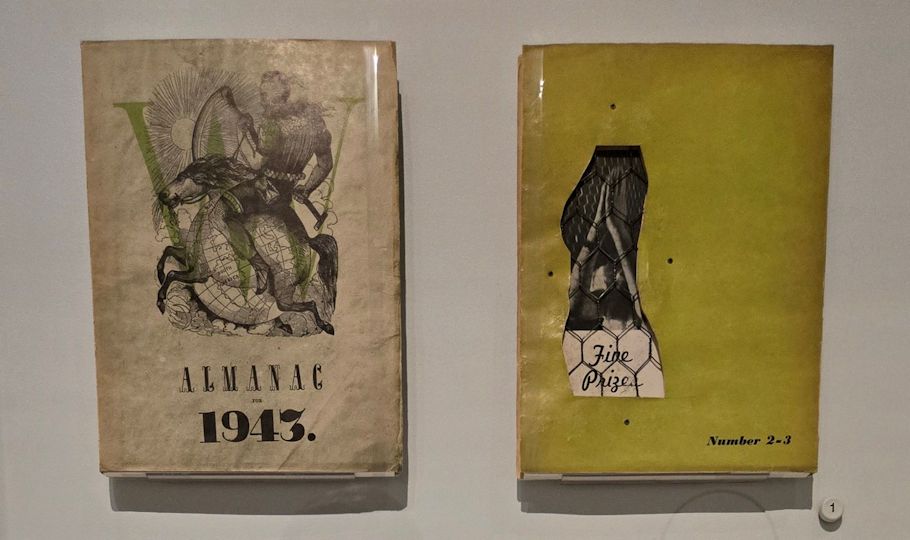
In the current number entitled "Almanac for 1943", it is Duchamp, now the third editorial advisor, who has designed the cover. On the front, overprinted with the title of the magazine, Duchamp has used a readymade print, Allegory of Death: a "bizarre horseman", armed with a scythe, wears a doublet decorated with the stars and stripes; his mount has the characteristics of both a globe and a horse, incorporating the sun above it and a crescent moon below.
The back cover has been fashioned with the assistance of Frederick Kiesler: a female torso in profile, drawn by Duchamp, has been cut out and wire netting inserted in the opening. On the last page, opposite the inside back cover, there is a photograph of Peggy Guggenheim's daughter, Pegeen Guggenheim, showing readers how to preform the "Twin-Touch-Test": "Put the magazine flat on the table, lift back cover into vertical position, join hands on both sides of the wire screen towards you."
Ephemerides
2026.10.15
Philadelphia Museum of Art
1943.09.19
1943. Sunday, New York City
"What a surprise to hear from you," writes Marcel to Yvonne, his companion in Buenos Aires [19.9.1918], who has since married and lives in London [16.7.1927]. He has arranged to have lunch today with her son, Peter Lyon, who is in New York for two or three days from Boston.
"I have been here a year and a half," Marcel explains, "Just getting by here--little enthusiasm for painting at the moment as you can well imagine." As for the family, "everyone is well." The last time he saw the Villons and Magdeleine was when he left Paris [23.6.1941]; the Crottis moved to the south of France and, while waiting a year for his visa [21.3 .1942], Marcel was in Sanary, where his sister Yvonne lives.
Promising to send her copies of VVV [13.3.1943], Marcel asks Yvonne to give greetings to the Penroses, Mesens, Ernestine [?], and Gaby Picabia, who narrowly escaped the Gestapo and is now in London with her daughter Jeannine.
Ephemerides
1944.09.21
1944. Thursday, New York City
"Your letter which I kept preciously is dated 24 Nov. 43," writes Marcel to Yvonne whom he last wrote to a year ago [19.9.1943]. And he has finally posted the promised VVV [13.3.1943] today.
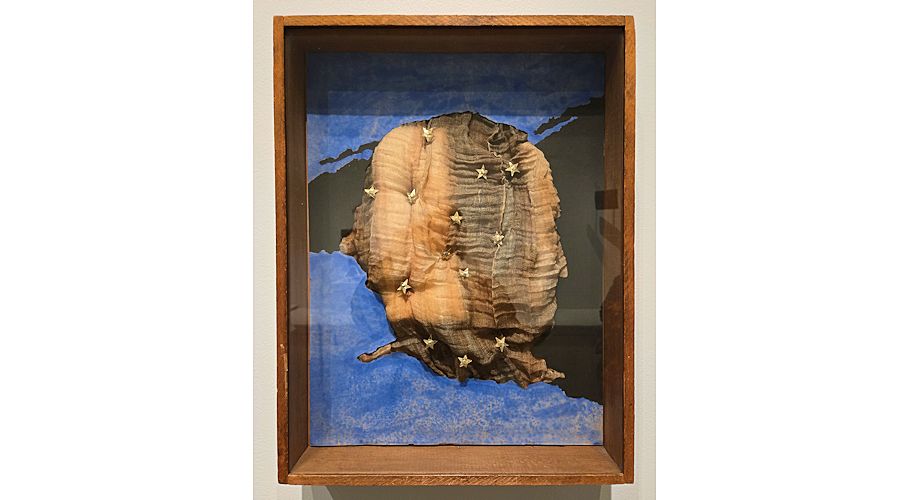
As well as issue no. 2/3, Marcel sends Yvonne a copy of VVV no. 4, in which his composition Allégorie de Genre is illustrated. Destined originally as a George Washington cover for Vogue, which the editors rejected, the profile of the first American president's head is composed of iodine-stained absorbent pads covered in gauze and stuck through with 13 nails, the heads of which are each decorated with a glittering gold star. This gory double image of America's glorious Stars and Stripes, and the victor of the American War of Independence, is fixed to the flat, black profile of the country set in a very vivid, almost electric sea of midnight blue.
Marcel has not seen the Arensbergs: "They stay in California," he explains, "I cannot afford the luxury of the voyage... They are very isolated and see hardly anybody except foreigners who ask to visit their collection."
Compared with Paris, Marcel says: "New York obviously has been a paradise for me but the human animal is so stupid that one ends up by no longer seeing any paradise."
As only the letters from America destined for the Calvados and the Manche are permitted in France, Marcel asks Yvonne if she knows of anyone either civilian or in the forces who could transmit a letter to Villon. "Be kind enough then to reply to me by return," he requests, "so that I send you a note to forward to the Villons if it's possible."
Marcel anticipates staying "at least a year" more in New York, forecasting that "even if the war ends tomorrow, people won't be allowed to leave easily..." A further detail about New York: "The burlesques have been withdrawn."
Ephemerides
2026.06.20
arrived with today's mail

 
and now there's lots to conjure with
2026.06.23
One of John Schiff's photographs...
...of Marcel Duchamp's Sixteen Miles of String installation at the "The First Papers of Surrealism" exposition is featured on page 86 of VVV No. 2-3 upside-down. Since Duchamp was one of the editorial advisors of VVV No. 2-3, I believe the inverted image manifests a direct Duchamp intention, because I also believe if the image being inverted reflects a printing error, then Duchamp would have subsequently called the inverted image a "by chance" readymade.

Stephen Lauf Anyway You Look, He's Never Without Strings Attached: another addition to the otherwise Complete Works 2026.06.23
2026.06.28
Autopsy of an 83 year old (magazine): the taking apart of VVV Number 2-3

[The] autopsy [here] is a detailed [intellectual/artistic] examination and [mostly careful] dissection of a [somewhat 'coffined'] body [of pages]. Also known as [an iconoclastic] post-[purchase fixation], its primary purpose is to determine the exact cause, time, and manner of [academic rigor mortis], as well as to evaluate the presence of any [']diseases['] or [prior] injuries.
2026.06.29
VVV Number 2-3 unbound
 
This is a quick digital record of the order in which the bound pages of VVV 2-3 were published.
2026.08.18
scanning VVV Number 2-3

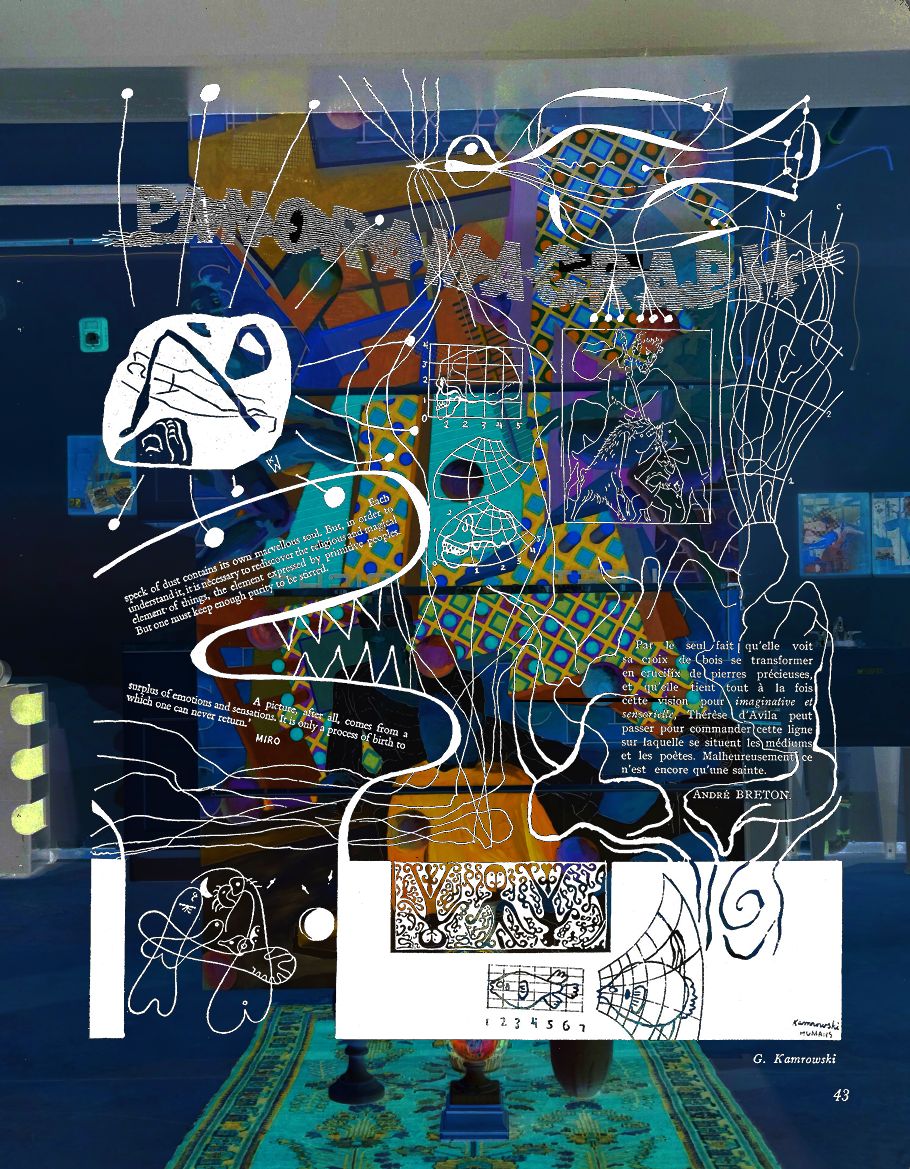
Since a dozen of VVV's initial pages contain images of postage stamps, I took the time to search through my own stamp collection to see whether I owned any of the stamps depicted.

2026.08.19
scanning VVV Number 2-3, etc.

2026.08.21
scanning VVV Number 2-3, etc.

2026.08.22
scanning VVV Number 2-3, etc.

2026.08.24
scanning VVV Number 2-3, etc.
2026.08.25
scanning VVV Number 2-3, etc.

2026.09.12
museum open .260912pm


2024.11.17
photography

makeshift storage
2017.11.17
POPICA

008
2009.11.17
The current state of Architectural Theory
Perhaps the struggle today is more with the dual reality of "anything goes" and "whatever works".
2006.11.17
Wildwood Daze
 
126
2002.11.17
Re: Yale School of Art
I'm glad I never went to any art school—I went to undergrad architecture school—because I'm now very appreciative of self-education, in that it is doable with better than satisfactory results. For example, it's recently become clear that I can more than hold my own when it comes to understanding Duchamp, as evidenced at the www Duchamp bulletin board.
After many years of self-education one begins to realize that one is learning not only what is being taught, but also a lot of what is not being taught. The more I understand the value of self-education, however, the less value I see in academia, because academia very often chooses to ignore that which is not from academia. Imagine, for example, that some artist or art historian student or teacher at Yale recently discovered a heretofore unknown printing by Piranesi. Chances are this discovery would have been deemed worthy of fairly wide press coverage and considered a significant contribution to the history of art. Of course, this never happened recently in academia, but some self-taught architect/artist did discovery a heretofore unknown printing of Piranesi's Ichnographia Campus Martius, published the finding online, and received confirmation via email from Piranesi scholar John Wilton-Ely (editor of the "complete" etchings of Piranesi) that indeed our knowledge of Piranesi's etching is not necessarily complete. Because this news did not come from academia, academia pays no attention to it, yet at the same time there is no question that academia's knowledge of Piranesi is now definitely lacking.
I think any artist would agree that it would for sure be thrilling to personally discover something like a lost/unknown Michelangelo. In all honesty, I can now very much claim a visceral understanding of what that thrill might just really be like, and I also feel that I probably would have never learned this sensation if I went to art school.
1994.11.17
diaphragm Timepiece of Humanity note
[In the future,] while the present is passing through the diaphragm, there is a period of transition between the upper organs of the digestive system and the lungs, a transition from metabolic imagination to osmotic imagination. This transition goes on for almost 400 years. When the transition to osmotic imagination is complete and osmotic imagination is 100%, that is when the heart enters the picture. One could say that the total osmotic imagination signals the start of the heart, the start of the pump.
1984.11.17
details of The Unfinished Dick Manifesto
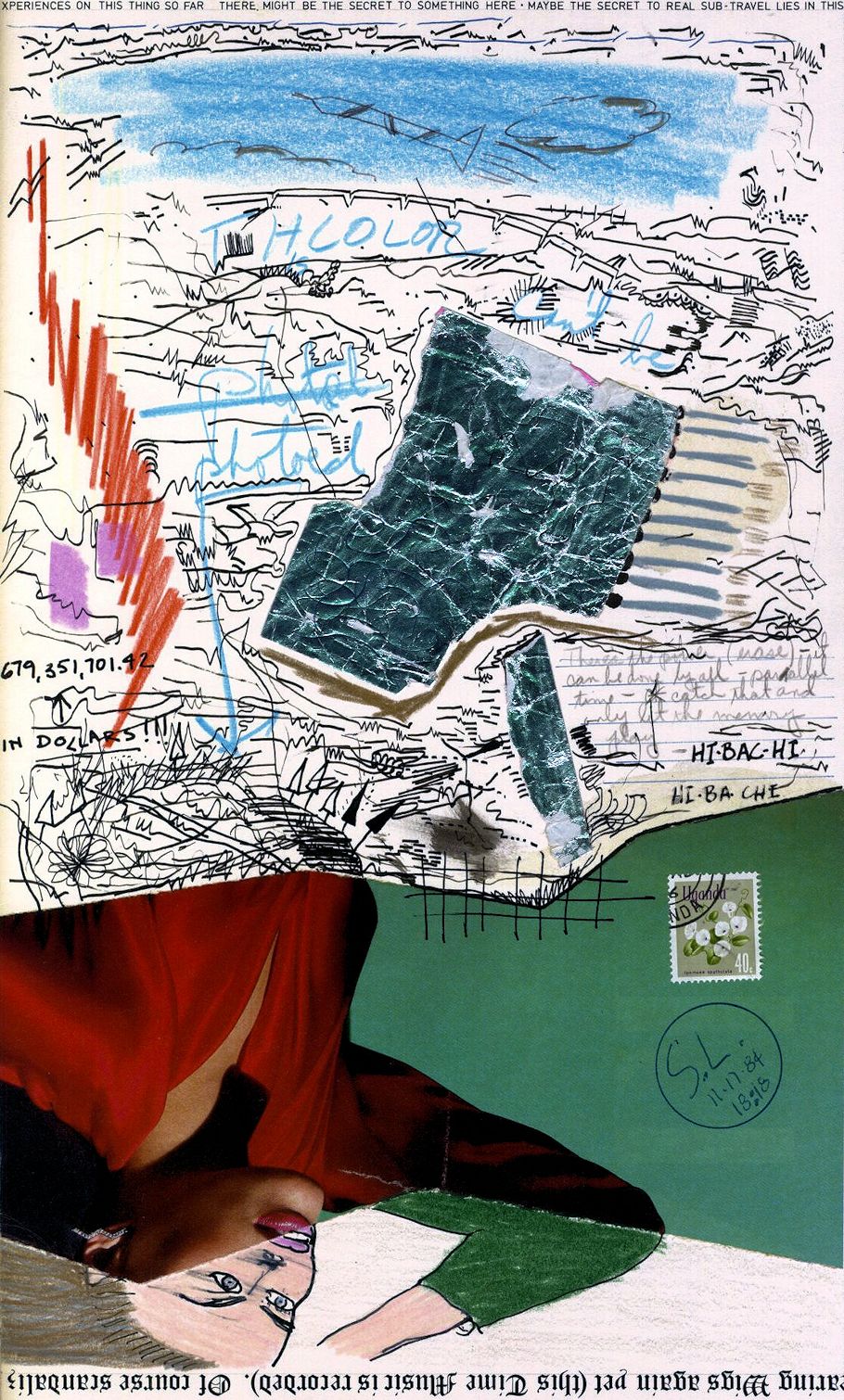
and only let the memory play

I am now
1966.11.17
1966. Thursday, New York City
At four-thirty in the afternoon Duchamp meets Monique Fong.
Ephemerides
1917.11.17
1917. Saturday, New York City
A painting by Louis Eilshemius [10.4.1917] was purchased for Walter Arensberg at an auction held at the Penguin Club on 10 November; Walter then, three days later, gave the picture to Roché, who in turn arranges for Albert Gleizes to deliver it today to Marcel.
Ephemerides
|